My sister brought me and my friend to the upside down house (Rumah Terbalik) when I was back home for the weekend.
Sabah has lots of gorgeous natural tourist attractions so it was very funny to find this man-made attraction that’s trying a bit too hard to be popular.
The location of the attraction is very far from the city center. Even with our own car, we drove kilometers and kilometers until we are at the foot of the route to Mt Kinabalu!
To find your way to the house, you will need to pass the water reservoir on the way to Tamparuli. The house is next to the Shell station after the famous Tamparuli bridge (it even has it own song–“Jambatan Tamparuli”!).
There’s an entrance fee and locals pay a bit lesser than foreigners.
The rules there say you are not allowed to take photos of the inside of the house but you can take as many photos as you want outside.
You will be fined 100 ringgit if you are caught taking photos inside the house. (What draconian rules.) The employees said it’s to preserve the uniqueness of the house. Pfft.
Inside the upside down house
The inside of the house is more fascinating than the outside. It’s a rather tiny home and everyone has to crowd on the red carpet.
The layout of the house is a typical Malay home sort of place, except everything is glued to the ceiling.
There’s a living room, two bedrooms, one bathroom and a kitchen. There’s spare change scattered on the floor and even a bucket of KFC–a cute touch.
My favorite is the upside down washing machine because I didn’t catch it (not literally) until I was far away from it.
The backside of the house is really cute because of the upside down bicycle.
The most interesting exhibit is the upside down Kancil with upside down Angry Birds dolls. I tried to pose like I’m hanging outside a car, waiting for Spiderman to save me.
When AirAsia was having a promotion for Japan in February last year, I chose to travel in mid-October, thinking I might catch the red leaves season.
Unfortunately, I was too early for the red leaves.
Pitiful red leaves
Fortunately, I was in time for the Jidai Matsuri, a Japanese festival I have been hoping to catch for a long long time.
Jidai Matsuti, or the Festival of the Ages, is a long parade where people dress up in period costume (sometimes representing historical characters) [inset Japanese history fan girl cheer here] stroll through a fixed path from the Old Imperial Palace to the Hei’an Shrine.
It’s one of the three major festivals in Kyoto and falls on October 22 yearly. The parade is to celebrate the move of Japan’s capital from Kyoto to Tokyo way way back. (You know what Wikipedia is for.)
I arranged our Kansai trip so that we will be able to watch the parade. Our hostel receptionist advised us to take the subway since some roads are blocked.
When we reached the subway station nearest to the starting point of the festival, there were a lot of people. Following not very clear road signs, we found ourselves next to the stoney path of the Old Imperial Palace.
There are paid seats but we didn’t get those so we sat on the stones along with the old uncles and aunties.
Rocky pavement
Mom waited at our “seats” while I went off to take pictures of the performers.
Some people also brought their dogs along.
It took a while of waiting before the event started. The two obasan (aunties) in front passed us coffee candy while we waited. That was sweet of them.
The announcement of the start of the parade came and I waited excitedly.
Some ladies had a banner congratulation Kyoto’s 1300th birthday as a capital.
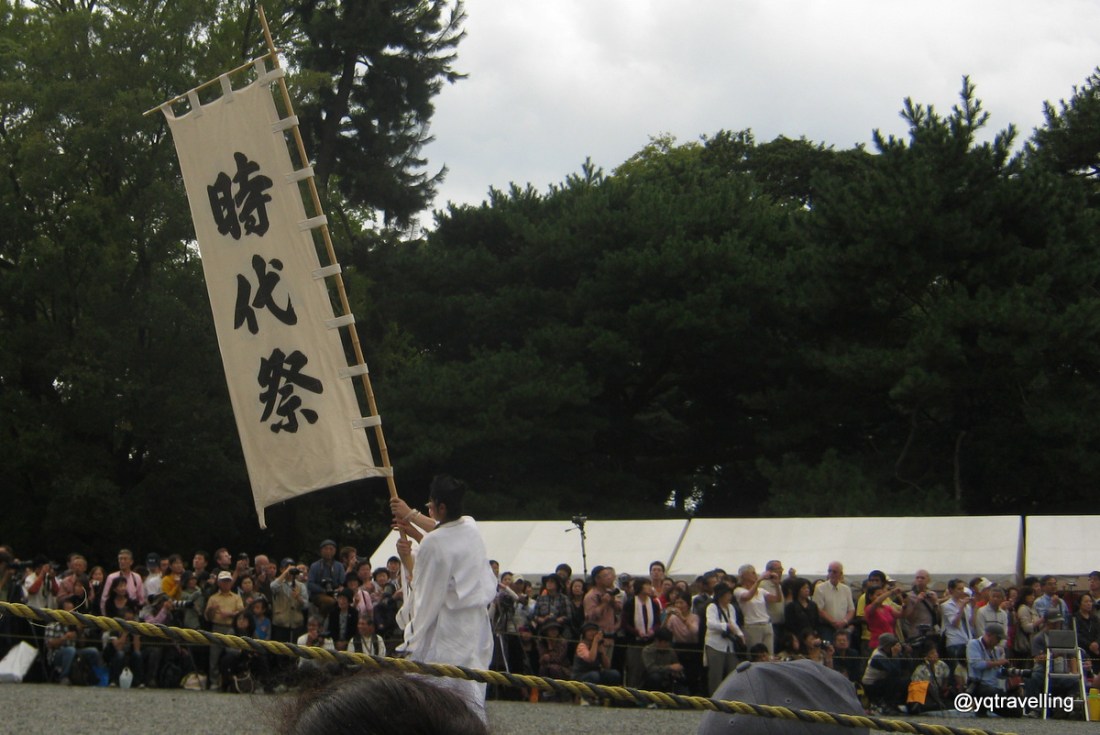
And a man carried a flag announcing JIDAI MATSURI.
The parade started with the Meiji period when the country was westernized. Then the more fun costumes followed.
The women of Jidai Matsuri
I’ve always been fascinated by famous women in history because fewer women than men are recorded in history. I want to know how they overcome gender inequality to have a place in history books.
I want to know what sort of power they have over the men and their children. How can this power translate to our modern world?
It seems to me that Japanese history has many wonderfully romanticized female figures–some arepoets, writers, great beauties or wives of famous men.
Murasaki Shikibu, author of The Tale of GenjiPrincess KazuDaughter of Ki no TsurayukiOno no KomachiKudara-O-Myoshin
Reflections of Jidai Matsuri
The procession was oddly solemn. No one cheered, not even when the popular historical characters like Sakamoto Ryoma stroll by.
I wanted to stand up, clap and holler “BRAVO!” but didn’t because everyone else was quiet. The only time when the audience was lively was when a band comes along playing music.
Also, I regret not having internet to google every character that I do not recognize because of my very shallow knowledge of Japan history. It would be more exciting to know who that man in blue pants is.
Tips for viewing Jidai Matsuri
Take the subway to the location: Some roads are closed for the procession so your best bet is the underground.
Bring a stool or something to put your butt on: If you are in the rocky grounds at start of the parade, a stool would help your butt from being too painful.
Bring food and drinks and an umbrella
Have you been to any celebrations with period costumes? How was it?
Week 27 of the Indie Travel Challenge is all about celebrating: There are many reasons to travel and many moments make traveling special. Have you ever traveled to another country during a new [to you] holiday? If so, what was special about it?
I just came back from a weekend trip back home to attend the wedding banquet of two high school classmates in Kota Kinabalu. Maybe I should say, the wedding of one couple who were both my high school classmates.
This post will be about Chinese weddings in Malaysia. From first hand witnesses, I’ve found out that Chinese weddings differ in Malaysia, Indonesia and China, so I’m trying not to lump every Chinese wedding together.
Here’s the lowdown of what goes on in a modern Chinese wedding in Malaysia.
The wedding would take about a year of preparation (from what I’ve heard). Not only is there the wedding certificate signing thing to finish, there is also the morning traditional ceremony and the dinner banquet.
If the family has lots of ties (relations, family friends, colleagues, business partners etc), we can expect an elaborate wedding banquet comprising of three changes of evening gowns and a hall-full of tables.
The first time I’ve ever tried deep fried duck was in Indonesia.
Compared to the fat (injection induced) friend chicken I’ve eaten, fried duck (especially in Indonesia) is very skinny. Imagine roasted duck but drier and tougher. Yes, that’s how it tastes like. Not that it’s not tasty that way, but it’s just special.
Unlike back home where meat or vegetable play the main role in a meal, the rice is the leading character here. (Let’s ignore the raw veg, I don’t eat raw veg.)
There’s a special chilli that comes along with the dish. Unfortunately, I don’t eat chilli too so I can’t tell if it’s any good.
#FoodFri is a post up on each Friday featuring a dish or meals I’ve had when travelling (or staying put). Happy eating!
It’s the end of June and time for a mid-year review of my travel KPIs, and revise my KPIs for the rest of the year. (This sentence sound too depressingly like work.)
My travel resolutions set at the beginning of the year were:
1. Make flight bookings to Thailand and the Phillipines
–>Bangkok’s ticket is set. But I’ve ran out of leave for P’pines
2. Look less through the camera panel, instead straight at the scenery in front.
–>Does forgetting my camera during my bike ride to Sausolito count? Am I breaking the rules if I use my iPhone instead? This is so complicated!
3. When travelling, talk to a local and find out what they think is the best thing to do in town.
–>I used Yelp and found out what the locals thought were good food. Does that count as well?
4. While even CNNGo.com claiming Singapore as boring, I’ll find not boring activities to do, travel local and explore Singapore like it’s my first trip.
–>Travelling local seems to have been forgotten by me. Oops.
5. Start saving and planning for my 2013 round-the-world trip
–>I swear my bank balance looks exactly like it was at the beginning of the year. Argh
Are travel resolutions like the yellow brick road? Detouring wouldn’t hurt, would it?
After taking deep gulps of air (at least it’s not wine), I’ve decided to set (or revise) my travel resolutions:
1. Stop making new flight bookings. Finish my Malaysian travels (Five more to go!).
2. Eat more during travels for #FoodFri!
3. Stop being so dang shy and ask the e-mail address/twitter handle of the cute hostel guy.
4. Stop using so many “stops” in my travel resolution. Start using more starts!
5. Really start saving and reach that $20,000 goal for RTW. (If Stephanie from 20-something Traveling can do it, so can I!)
6. Continue my Sunday, Tue/Wed and #FoodFri posts. (Doing a good job sister!)
7. Start picking up conversational Spanish. (How should we measure the success for this?)
8. Start real research for #rtw2013.
This blog post was inspired by BootsnAll’s Indie Travel Challenge weekly travel blog project.
Week 26 of the Indie Travel Challenge is all about checking in on your resolutions from Week 1.
I usually read up on places I am visiting before a trip. Whether it is travel guides, blog posts, recommendation sites, I read them all.
I picked up <<To Vietnam with Love: A travel guide for the connoisseur>> as an afterthought. I was at the library and my arms were already heavy with two other guidebooks.
But I’m glad I did.
<<To Vietnam with Love>> is one of the rare travel guide books that breaks away from the tradition guidebook structure. (I believe the <<To Asia with Love>> series have have the same format.)
The “traditional” travel guide structure is the main reason I don’t review travel guides here.
In a regular guidebook, I find:
->History of City
->Sights to see
->Eat
->Accommodation
->Things to be careful of
->Nearby fun stuff
<<To Vietnam with Love>> is structured differently. Instead of having cities as chapters, it has different themes: Eating, Shopping, Sightseeing, Local culture and etc.
Under each theme, different writers introduce us to the Vietnam he or she has experienced. At the end of their story, there is a blue box that lists the addresses of the places mentioned.
A break from tradition
I was very much in love with this refreshing structure and the layout. The stories were short enough to keep me captivated. They were also useful since the authors give a part of the Vietnam they know to us. (But not very useful if you want a This is What You Should Do kind of travel advice.)
The introduction of the guidebook is spot on. After reading the stories, I felt like I was listening to someone’s travels in Vietnam after a dinner at someone’s house.
The book is also a contrast to other travel compilations.
One thing I don’t like about travel compilations such as <<The Best Women’s Travel Writing>> (please don’t blacklist me) is the length of the stories and the layout of the page.
Most of the pieces of such compilations are long short-story. The text spans from the left border to the right. Adding these two together makes a rather unpleasant pleasant reading experience, even though the stories are great.
A caution to crybabies
Most of the writers in the book are Americans. Since the US has fought in the Vietnam War, a lot of the stories were about revisiting the country as a veteran or a relative of the veteran.
A warning to emotional people like me, these war-related pieces made me weep over my lunch. (Heck, I wept when Hedwig died in the last Harry Potter book.) I had to wipe tears off my cheek or risk eating my tears in my porridge.
Overall, it is a very good book to have, especially if you are not visiting Vietnam. For folks who want itineraries, it’s much better to get the normal travel guidebooks.
Check out other interesting travel book reviews here:
How’s everyone’s week been? Mine was busy covering an annually tradeshow. Luckily, they keep us journalists pretty well-fed in the press hall so I’m a happy camper.
Today’s #FoodFri is a picnic lunch I had in the grounds of Fontainebleu Castel in France. As you can see, it’s not quite as scandalous as Manet’s <<Le déjeuner sur l’herbe>> but it was a peaceful lunch.
I bought the supplies from the Monoprix near the castle after I dropped off at two bus stops too far from my destination. I decided that I did not want to stress myself with ordering lunch en Francais so I bought couscous, chicken, yogurt and H20.
Being cold, pre-cooked food, it wasn’t the best tasting dish I’ve had in France but I’ve had a worse meal (instant noodles I brought from Singapore.) Sacrebleu!
I found a quiet spot overlooking the castle grounds.
Not far away, a kindergarten group was having their lunch.
I decided to skip Versailles and go to Fountainebleu because I know that if I ever come back to France with other people, I would be dragged to see the Sun King’s palace. Napoleon had stayed in this castle and there was an exhibition of his things in the castle.
#FoodFri, short for Food Friday, is a weekly post where I feature a dish I’ve had while travelling or a dish you should try when you come to Singapore.
While I do review travel-planing apps (erm.. Flight Lover only for now) here, today’s app is slightly different but still travel-related.
I started playing Pocket Planes last Friday. It’s created Nimblebit which also made Tiny Tower. This explains why I could not stop checking my phone and tapping the screen like a zombie.
The game is not as simple. Picking it up was frustrating since I did not know what I was supposed to do.
You need to fly passengers and cargo to different destinations on the map. First, you choose a country. I picked Japan because I love the Land of the Rising Sun. (Interestingly, my colleagues all chose Japan too, not sure why.)
Tip 0: Pick a region that you are familiar with
->I chose Japan because I know the country quite well. Plus, the locations aren’t very far from each other.
Then you start flying cargo or folks across the country, earning bitcoins and bux along the way.
Why is it addictive? Like Tiny Tower, there’s a waiting element then reward. Then there’s the panicking part where I fear that I am not earning all the bitcoins I can while I am awake.
Addictions happen silently.
The bitbook is totally cute too. And it has not reached the stage where I’ve read every single entry and its variation.
Some Pocket Planes tips
anWith all that playing, I’ve figured out some strategies that work for me. But since I’ve been playing for a while, I’m not sure which tip is for beginning player and which for more advanced player as reference.
For example, I assume you know that bux (the
Tip 1: Give good names
One important trick in the game is combos (explained in Tip 2), so I name my planes based on their functionality.
A plane that flies 1 passenger and 1 cargo is called 1P1C.
A plane that flies no passenger and 2 cargo is called 0P2C.
Tip 2: C-c-c-combo! In case you are not joined at the hip to the Internet like I am, it’s supposed to be c-c-c-combo breaker.
Combos work like dream jobs in Tiny Tower. You earn an extra 25 percent if your cargo/passengers are heading to the same location and you fly them there.
Tip 3: Build planes with multiple seats, cargo area.
Do not buy fully-made planes! I was stupid enough to do that. Related to Tip 2, you should save your bux to buy parts of planes with multiple seats/cargo area.
For more advanced players, planes have different classes and some airports don’t take classes higher than theirs. Example, only Osaka, Tokyo and Seoul are able to receive Class 2 planes.
Tip 4: Don’t bother with small airports
Once I saved up enough bux, I started buying airports. Unfortunately, an airport like Vladivostok with a population of 0.6M means my planes are stuck there with nothing to send.
I usually end up flying with an empty plane from Vladivostok to busier airports. I had to close down Vladivostok, wasting my upgrades and airport buying fee.
Now that I have the three major hubs, Osaka, Tokyo and Seoul, my planes fly almost none stop between them.
Tip 5: Layover’s your other best friend
A combo flight is the best but you can’t get one most of the time. I would fly a plane with passengers or cargo that have different destinations and stop at the nearest. (You get the same money no matter how heavy your cargo is.)
At the new airport, I would offload my cargo so that other planes can have combos, or pick up cargo to turn my flight into a combo flight.
Does that make sense?
Tip 6: Eliminate weak planes
When you have enough bux, buy multi function planes and retire single function aircrafts (eg 0P1C, 1P0C).
Since airplane slots cost bitcoins, it’s better to remove not useful planes to the hanger than fly one watermelon across the country.
Tip 7: Bring a charger
This is probably the most important tip for me. I cannot put it down and it’s draining my battery. ;)
Fly me to the end of the earth, captain!
Are you playing Pocket Planes? Can you share your tips?
Before I went to the US, I thought travelling there would be really expensive. But I realized that budget travel in San Francisco is possible after spending 8 nights in The City as a side trip of a business event.
While I’m not The Frugal Traveler, for the trip, my goal was to spend less than US$100 a day, including accommodation. I think I might have exceeded that budget because I bought tickets for some once-in-a-lifetime activities, shows and tours which easily costs about US$30 each.
In any case, I’m a frugal person to begin with so the trip was probably a budget travel success. Probably.
A short summary of the hostel reviews:
-Fisherman’s Wharf Hostel wins at free breakfast and nice view
-Pacific Tradewinds wins at having a fantastic location (and a cosy group, if you are a sociable person, which I am not).
Save on transportation and museums with CityPass
$6 for a ride?
The CityPass (US$69) was a good investment since I was in the city for 8 full days. It includes 7-days of transportation on MUNI buses and trams and the cable car, but not on BART, as well as 9-days admission to five different museums.
I did a spreadsheet before I headed off, taking away things like the aquarium and the one-hour cruise in the bay, but I realized that I would save money getting the pass.
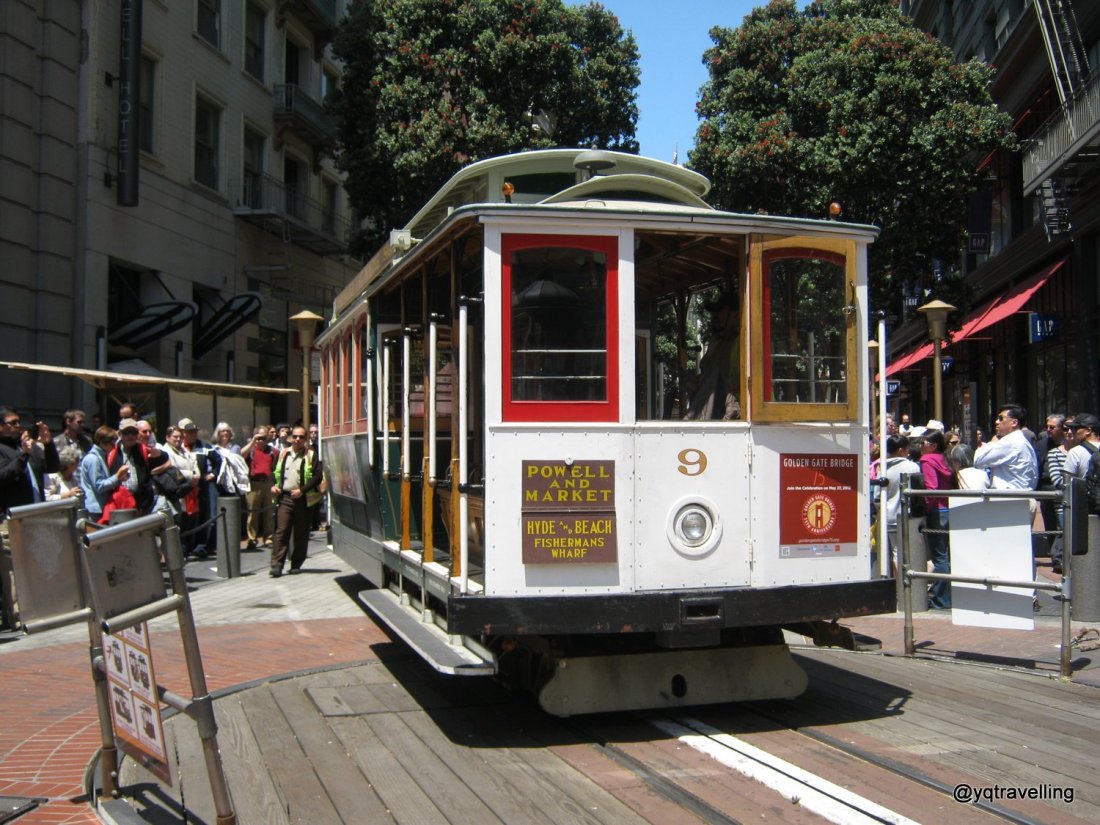
Sure, it was quite expensive. But it includes cable car rides which are US$6 one way–unfortunately, taken only by tourists. Just by taking the cable car 12 times, I would get my money back, not that I actually did it.
Turns out, the aquarium was actually very lovely. The other museums were even better. Sadly, I missed out on the California Academy of Science because there was other more exciting stuff for me.
There’s also an option for an Alcatraz Island tour with CityPass but you’ll need to personally head down to Pier 33 to get the booklet.
Save on food with Yelp
Thanks for the coffee
I love food too much to eat only cheap fast food while in San Francisco. Luckily, I have Yelp on my iPhone to guide me to good locations.
I usually narrow down my food choices to eateries with only one dollar sign (cheap!). I also use the checkin coupons to save on drinks. Since I do not have 3G on my phone, I would redeem the coupon first then show the folks at the restaurant my coupon later.
I’ve managed to save 50% on my latte at M Cafe, grab a free coffee at Sushi Taka and 15 percent off some stuff at a shop-which-will-not-be-named.
Save on sunscreen with Walmart
2 for $5? How can it be this cheap?
Surprisingly, sunscreen is a lot cheaper in the US than in Singapore or Malaysia.
Walmart was selling its homebranded baby sunscreen at 2 for US$5. It took all my willpower to only take four in my basket. I wanted to take 10.
The sunscreen worked very well. I didn’t get sunburnt on my cycling trip to Sausolito. (OK, maybe wrapping myself in an oversized cardigan, a scarf around my neck and tights helped.)
Save on clothes with thrift shops
Thrift Town
K introduced me to thirft stores in San Francisco. I was in luck that day because I immediately found an oversized cardigan at the first store we stopped at. It was only $5 after I rounded to price up for donation. The blue and white cardigan was only $5
Unlike Kota Kinabalu’s second hand clothes stalls, thirft shops in San Francisco are very organized. Instead of musty old clothes smell, their stuff are perfumed with softener.
Since I wore my clothes immediately, I felt very conscious of other people smelling the thrift store smell on me. (But it’s probably all in my head.)
I also bought two dresses from Thrift Town and a vintage belt from this other place.
Favorite store: Thrift Town
Address:
2101 Mission St
(between 17th St & Clarion Aly)
San Francisco, CA 94110
Neighborhood: Mission
Save on books with second hand bookstores
Adobe Bookstore
Similar to thrift shops, I love the second hand bookstore I found in San Francisco.
I picked up two books. One was the Spanish version of Bridget Jones’ Diary which is pretty much priceless in Singapore because it cannot be found.
There was also a 30 percent discount at Adobe Bookstore because it was closing down. It was rather sad that the building owner was raising the rent too high for the bookstore owner.
Address:
3166 16th St
(at Albion St)
San Francisco, CA 94103
Neighborhood: Mission
Save on once-in-a-lifetime experiences by reading local papers
This was actually in San Jose
I picked up a free SF Weekly as reading material from one of the newspaper-dispensing things. I flipped through the events listing while having breakfast and almost had a heart attack when I saw that Dita von Teese’s Strip Strip Hooray show was in town for a two-night performance.
The last time Dita was in Singapore, it was a local star-studded event! And I believe tickets weren’t even for sale. So this show was a not-to-be missed for me.
For SF, the standing-room ticket was only US$35. When I tried buying online, tickets were sold out. I decided to try my luck at the box office and tickets were still available. Strip strip hooray
While I had to stand for a full three hours and look past other people’s head to peep at the stage, the atmosphere was amazing. People cheered and I cheered myself almost hoarse. The host was funny, the audience who were asked to go on stage for a dance competition were really sporting too.
And I got to breathe the same air as Dita von Teese! OK, that might be a bit stalkerish, but it’s DITA (Warning: That video is more Fatal Frame rather than sexy.)