In case you don’t know, I’m now in Japan. I’ll be in Tokyo for a week for a work trip. The first two days are my free day and my real work will start on Monday evening.
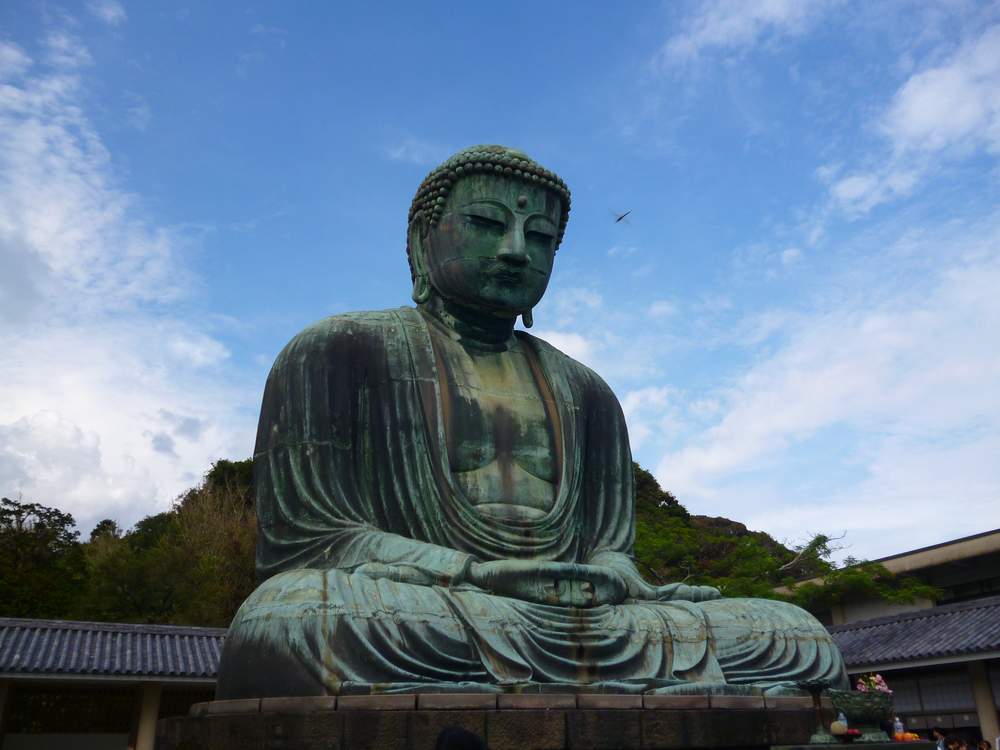
Today, I went to Kamakura despite preparing for Yokohama. I found out that my N’EX and Suica package covers Kamakura so I decided to visit the ancient city.
I didn’t do much preparations for Kamakura (the prep I actually did for Kamakura was accidental and is part of the last bit on Yokohama that I photocopied from Lonely Planet).
It worked out of course, nothing a bit of walking around and getting lost won’t help (I hate asking for directions). Until tomorrow!
Floating udon
When I was a kid, having Japanese food was a rare treat.
The Japanese restaurant that my family goes to most often started its business when I was just in high school. The place was different from the usual rowdy Chinese restaurants and had beautiful finished puzzles of Japanese beauties on the wall.
Each university vacation, my parents would take the family to the Japanese restaurant–Miyabi–for dinner. For me, Japanese food signified family.
Before my trip to Japan for summer school at the end of my third year, I read about the variety of Japanese food in my guidebooks. Back then, I didn’t understand why anyone would choose to eat wasabi. For me, Japanese food signified the exotic.
Today, I voluntarily scoop out the green spicy paste and mix a bit of soy sauce to it. I could slurp a bowl of udon/ramen as loudly as the Japanese businessman could. For me, Japanese food signified delicious meals.
Now, I am finishing this post at Changi Airport. In 8 hours, I will be in Tokyo where I will spend the weekend having fun before starting my business trip on Monday.
Even though I have not fully planned out my itinerary, I have made up my mind what I want to eat: sushi at Tsukiji, Monjayaki, udon, ramen, old Edo-styled tempura, rice balls from the convenience store and lots and lots of cheap conveyor belt sushi.
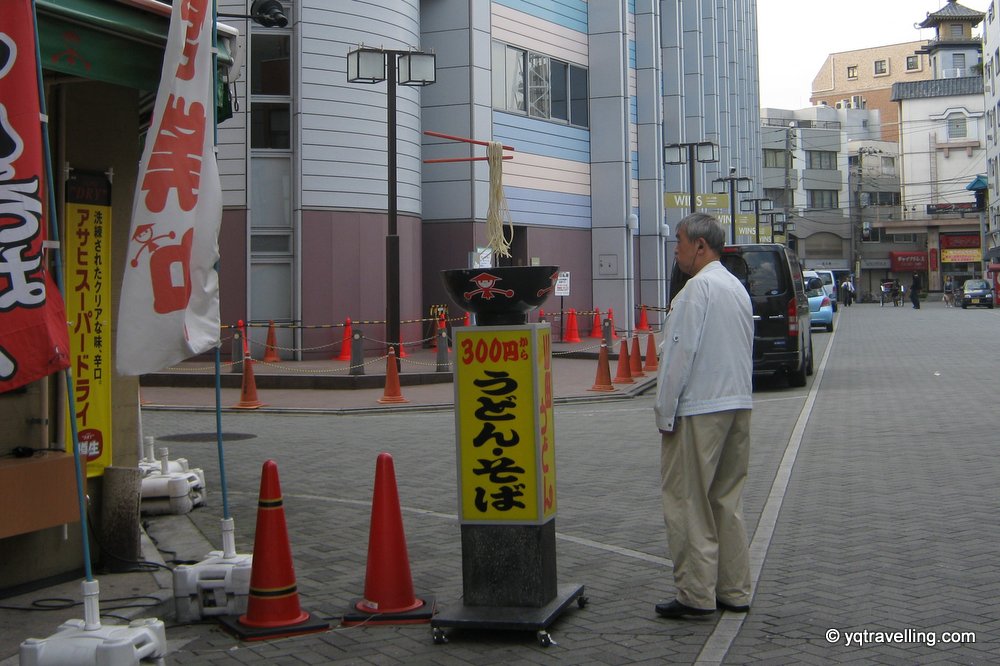
I leave you with this fascinating outdoor advertisement for a udon shop.
This blog post was inspired by BootsnAll’s Indie Travel Challenge weekly travel blog project.
Week 35 of the Indie Travel Challenge is all about Food in Asia: You have to pick one country in Asia to eat from for a month. What country do you pick? Why?
I have a confession. I have very bad taste in music: I love viral music.
Back when Rebecca Black’s Friday and Carly Rae Jepsen’s Call Me Maybe were popular, I listened to them repeatedly on Youtube not ironically but with full appreciation of the catchy lyrics and head bobbing tunes.
Currently on my Youtube loop (because I cannot buy it from the Singapore iTunes) is GANGNAM STYLE from PSY. Youtube charts
I thought about sharing the deep meaning of the song which parodies the dirt rich in Korea but I thought it would make you click the X button. Instead, I have compiled a list of Top 5 (in no particular order) covers of PSY’s song. (And leave the heavy reading to WSJ.)
From Malaysia:
ORANG SABAH STYLE (OPPA GANGNAM STYLE PARODY)
A Hakka version of Gangnam Style featuring my hometown (or homestate) Sabah. Lots of locations taken at places I am familiar with. The ending even has Bruno Mars.
Best line: Come to Sabah, wanna try the seafood. Go to island, Hey!
GANGNAM (SUPER KAMPUNG) STYLE
This is a version made by a Malaysian radio station. I think it’s really cool that the employees are sporting enough to do the invisible horse riding dance everywhere in KL.
Best line: “But in your kampung, you can wear sarong. Anywhere you go oh. Everybody knows oh.”
From Taiwan:
這群人 – 學尬乾那塞 (GANGNAM STYLE Cover/Skit/台語版)
“Studied like Shit”
A Mandarin + Taiwanese Hokkien version with a sexy dressed as a teacher/librarian. Sex sells, of course. Best line (translated): You… don’t study. Learn! Learn! Learn! Learn! Studied like shit
From Singapore:
Singaporean Style (Gangnam Style Parody)
Best part: Instead of the invisible horse riding dance, they have a shake your fist up and down dance.
Best line: “Ehhhhhh give me Tau Huay”
From Korea:
PSY (ft. HYUNA) 오빤 딱 내 스타일
“‘Oppa Is Just My Style”
OK, I’m cheating with this video. It’s actually a follow up to the original song, sung from the girl’s point of view.
UPDATE: Oppa KL Style
From KL, again.
The original video
PSY – GANGNAM STYLE (강남스타일) M/V
Have you found any interesting covers of GANGNAM STYLE?
I was at a travel blogging workshop when I found out through Twitter that AirAsia blog published my A Day in Osaka post. (Check out the post at the AirAsia blog if you haven’t read it yet.)
A Day in Osaka on AirAsia blog
A big welcome to new readers (and a virtual high five to old readers).
If you have any questions about travelling in Singapore/travelling solo as a female/travelling solo as a shy person, drop me an e-mail : yqtravelling[at]gmail.com, tweet me or even comment down below (unless you’re too shy, I understand that).
You know how the west (and Americans) have one night of Halloween to play dress up, ask for candy and honor the dead?
Guess what, we Chinese have a whole month of that but minus the dressing up, candy or playful spirits.
What we have instead is the opening of Hell Mouth and a bunch of Hungry Ghosts.
Welcome to the Ghost Month
Offerings
The Ghost Month begins on the 7th month of the Chinese lunar calendar. In 2012, the first day of the 7th month falls on Aug. 17, Friday.
On the first day of the 7th month, it is said that the gates of hell open and the spirits leave the underworld and come back to visit their families. Unfortunately for homeless ghosts, they would have no where to go and would roam the earth.
To appease these homeless (and most likely hungry) ghosts, the Chinese would burn “hell money” and incense as well as put out food to feed the hungry ghosts. Paper money burning place
Getai
Besides all the money burning, there’s an interesting event happening in Ghost Month.
In neighborhoods in Singapore, outdoor stages are set up. At special days, these stages transform into “getai” or “song stage”. From an old Hong Kong movie I watched, the shows are performed for the benefit of the wandering spirits.
I’ve only been to one getai performance because we don’t have this sort of stuff back home in KK. The getai that I went to had a small stage, which disappointed me. Mini getai
There was a host who told jokes and young sexy singers who sang and danced. The usual female singers for getai are known for their skimpy outfits and high heels.
If you are interested in seeing a getai, the performance schedules for 2012 is available at STOMP.
I suppose the sexy ladies are there for the benefit of the sex-hungry ghosts as well. Unfortunately, I have yet to hear an equivalent Chippendale performances for the lady ghosts. I assume hell does not support equal rights. If I were a ghost, I will petition for a male stripper show.
My experience with Ghost Month
I cannot describe the fear I have of Ghost Month as a child. To the little me, ghosts lurked everywhere in the 7th month and were out to get me.
There are superstitions such as: Never turn back when walking alone at night if you hear someone call your name. Also, try not to go swimming because the spirits of those who drowned will want to put you down to replace their place.
Today, I don’t fear Ghost Month. I have a wish to see a real ghost and get proof of it so everybody else can rest in peace that our spirits do stay back after death.
Do you have a similar festival as Ghost Month back home? Or do you have ghost stories to share? (I love ghost stories.)
My #FoodFris are turning into Supper Fridays with all these late posts.
Today, instead of a dish, I want to show you something special from Japan.
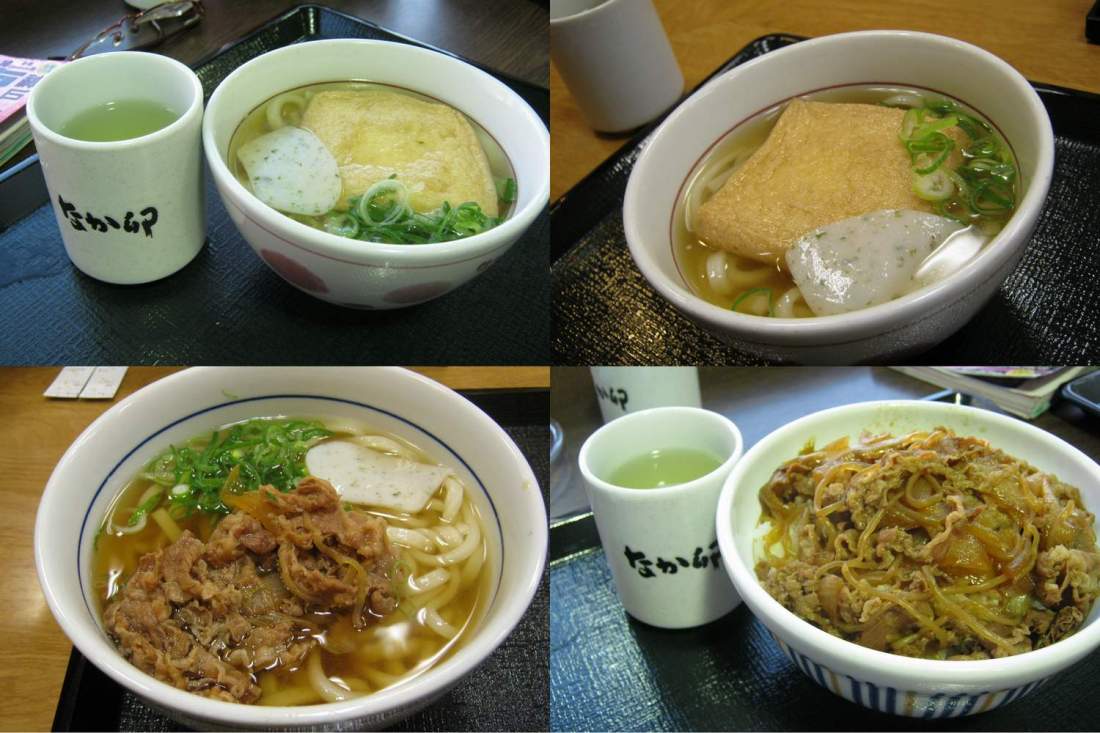
Nakau is a fast food chain in the Land of the Rising Sun. They don’t serve burgers or fries but Japanese food such as noodle and rice.
Piping hot
We had these during our trip to Kyoto last year. The meals were not drastically expensive but my mom wasn’t very impressed by our second meal. I still can eat five more bowls of udon before I surrender.
Easy meal
Nakau machine <3
What’s great about the chain is that even if you do not know Japanese, you can order a meal. They have coupon machines with pictures of the dishes and the price. Feed it your cash and it will spit out a coupon. Pass the coupon as you settle down at the counter and the food will arrive very soon.
However, I’ve heard that single ladies do not visit such establishments alone. It has to do with gender stereotype. Oh well, it doesn’t apply to visitors, I suppose.
When AirAsia was having a promotion for Japan in February last year, I chose to travel in mid-October, thinking I might catch the red leaves season.
Unfortunately, I was too early for the red leaves.
Pitiful red leaves
Fortunately, I was in time for the Jidai Matsuri, a Japanese festival I have been hoping to catch for a long long time.
Jidai Matsuti, or the Festival of the Ages, is a long parade where people dress up in period costume (sometimes representing historical characters) [inset Japanese history fan girl cheer here] stroll through a fixed path from the Old Imperial Palace to the Hei’an Shrine.
It’s one of the three major festivals in Kyoto and falls on October 22 yearly. The parade is to celebrate the move of Japan’s capital from Kyoto to Tokyo way way back. (You know what Wikipedia is for.)
I arranged our Kansai trip so that we will be able to watch the parade. Our hostel receptionist advised us to take the subway since some roads are blocked.
When we reached the subway station nearest to the starting point of the festival, there were a lot of people. Following not very clear road signs, we found ourselves next to the stoney path of the Old Imperial Palace.
There are paid seats but we didn’t get those so we sat on the stones along with the old uncles and aunties.
Rocky pavement
Mom waited at our “seats” while I went off to take pictures of the performers.
Some people also brought their dogs along.
It took a while of waiting before the event started. The two obasan (aunties) in front passed us coffee candy while we waited. That was sweet of them.
The announcement of the start of the parade came and I waited excitedly.
Some ladies had a banner congratulation Kyoto’s 1300th birthday as a capital.
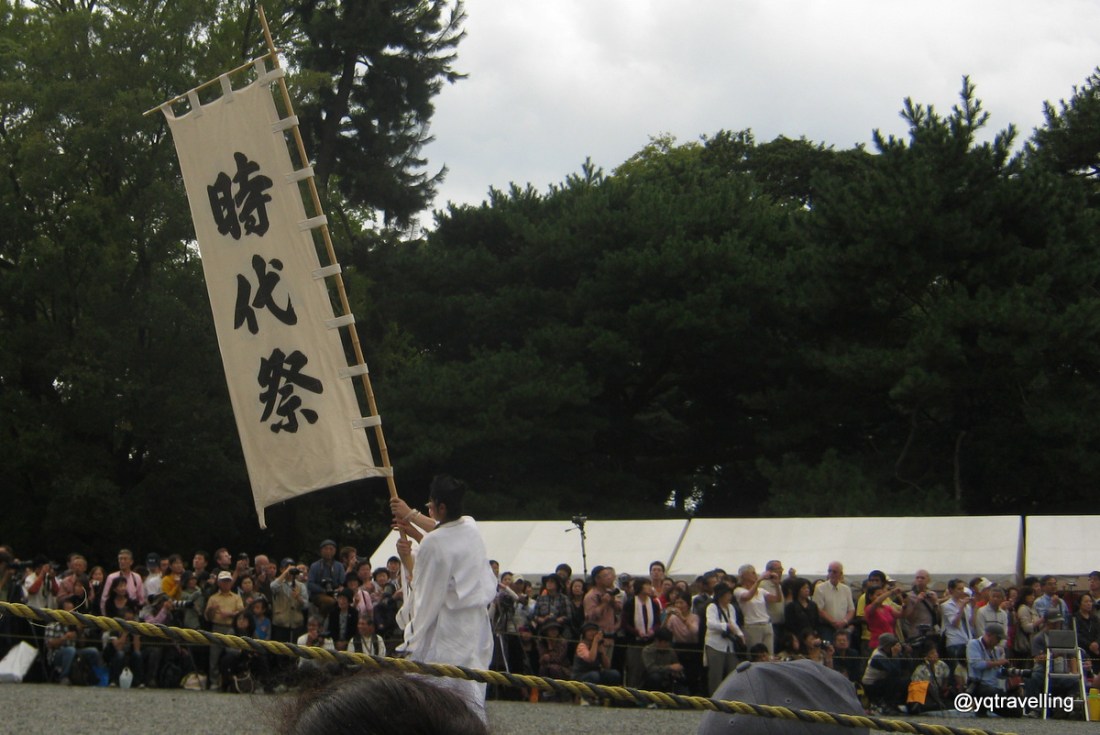
And a man carried a flag announcing JIDAI MATSURI.
The parade started with the Meiji period when the country was westernized. Then the more fun costumes followed.
The women of Jidai Matsuri
I’ve always been fascinated by famous women in history because fewer women than men are recorded in history. I want to know how they overcome gender inequality to have a place in history books.
I want to know what sort of power they have over the men and their children. How can this power translate to our modern world?
It seems to me that Japanese history has many wonderfully romanticized female figures–some arepoets, writers, great beauties or wives of famous men.
Murasaki Shikibu, author of The Tale of GenjiPrincess KazuDaughter of Ki no TsurayukiOno no KomachiKudara-O-Myoshin
Reflections of Jidai Matsuri
The procession was oddly solemn. No one cheered, not even when the popular historical characters like Sakamoto Ryoma stroll by.
I wanted to stand up, clap and holler “BRAVO!” but didn’t because everyone else was quiet. The only time when the audience was lively was when a band comes along playing music.
Also, I regret not having internet to google every character that I do not recognize because of my very shallow knowledge of Japan history. It would be more exciting to know who that man in blue pants is.
Tips for viewing Jidai Matsuri
Take the subway to the location: Some roads are closed for the procession so your best bet is the underground.
Bring a stool or something to put your butt on: If you are in the rocky grounds at start of the parade, a stool would help your butt from being too painful.
Bring food and drinks and an umbrella
Have you been to any celebrations with period costumes? How was it?
Week 27 of the Indie Travel Challenge is all about celebrating: There are many reasons to travel and many moments make traveling special. Have you ever traveled to another country during a new [to you] holiday? If so, what was special about it?
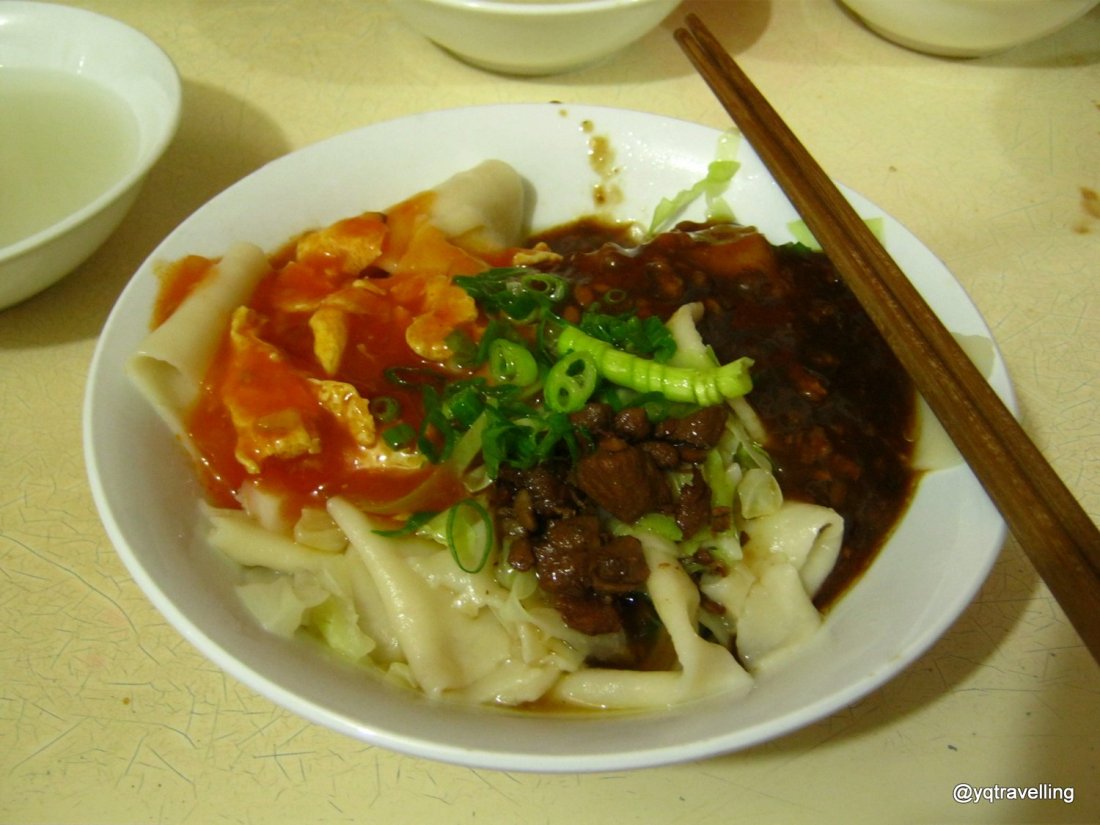
While we were in Xi’an last year, we went in search of an unpronounceable noodle dish. The Chinese writing for it looks like it would take two minutes to write just one character.
We didn’t know how to say the word, but we knew how to look and point.
We found a tiny stall with quite a lot of patrons. We settled down and sheepishly asked for a bowl each, mumbling our way through the name.
Biángbiáng noodles
Unfortunately, it wasn’t a terribly fantastic dish. Maybe we weren’t used to minced meat mixed with sauce and fried egg with tomator or maybe the stall wasn’t the best around.
From Wikipedia:
Made up of 58 strokes, the Chinese character for “biáng” is one of the most complex Chinese characters in contemporary usage, although the character is not found in modern dictionaries or even in the Kangxi dictionary.
I met another traveller, K, while I was in San Francisco. On our way to a taco place she loves, she asked what I usually do when I travel.
I thought for a short while and said: “Eat.”
I cannot imagine not trying local food in a new location. I usually detail my travel food diary in the Glutton-series and #FoodFri where I feature a yummy, or not, dish I’ve had.
Best dish I ever had
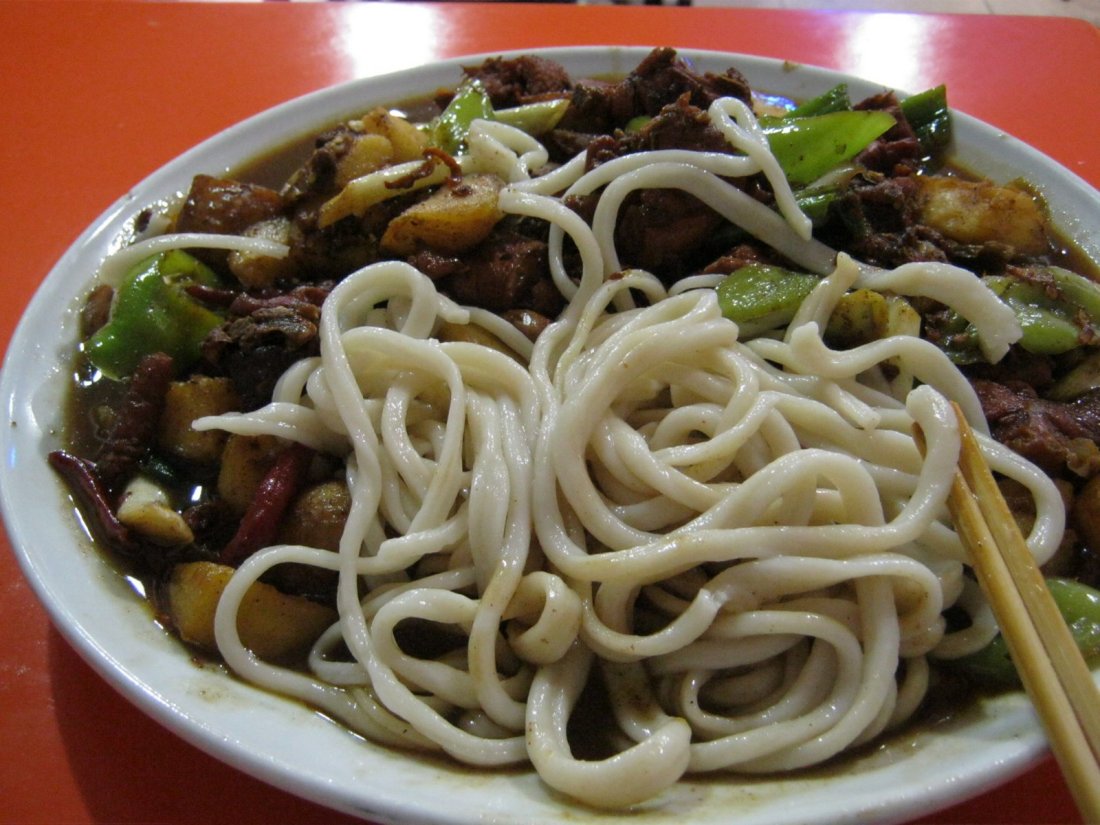
My most memorable dish has to be the noodles in my 大盘鸡(dapanji) in Luoyang, China.
I thought 大盘鸡, or roughly translated as “big plate of chicken”, was a literal big plate of steamed white chicken. Turns out, it’s chicken in soy sauce with potatoes.
The stall I went to only had portions for two people and more. I was alone but ordered the two-person set anyway.
I like chicken very much as I gobbled down the salty meat and the starchy potatoes. Just when I thought I could not eat another bite, one of the employees brought me a large plate of udon-like noodles.
I asked for half of the portion she gave me but regretted it once I bit into the noodles. It was too tasty!
It was a strange type of noodles. It was thick and white like udon but was more firm like ramen and more chewy.
Mixed with the salty soy sauce, the plain noodles transformed from boring Cinderella into the main character of the dish.
After I finished my small portion, I could not eat another bite which was a real pity.
Until this day, I dream of it… My beautiful chewy, white Chinese udon.














 YQtravelling