What staying at a Chinese-run hostel in Europe is like

Beds in dorm

The first time I was in Europe in Barcelona in 2009, I stayed at a Chinese-run hostel to save on accommodation.

This time in Florence, I did the same since accommodation in Italy isn’t that cheap.

A Chinese-run hostel is unlike the usual international hostel that you see:

  • The business usually doesn’t advertise on hostelbookers or similar sites (but I’ve seen one advertise on AirBnb).
  • The clientele is mainly Chinese-speaking people (as you would expect).
  • The hostel is in an apartment.

In Florence, I stayed in the Chinese-run hostel for 5 nights since it was one of the cheapest option around.

I paid 25 euro for each night  I spent in the dorm and paid an extra 5 euro for dinner. The price includes a Chinese breakfast every morning.

Back in Barcelona, I booked a double room for myself and was given a room large enough for 6. This time in Florence, I wasn’t able to be as generous with my money so I opted for a bed in the dorm.

On the night I went, my dorm which had 6 beds (including one unoccupied upper bunk) only had 4 residents. One of the beds was occupied by the other lady who helps out at the hostel.

However, on the busiest night, there were 8 people sleeping in it (with extra beds stuffed into the large space). The lady who helped out at the hostel had to sleep in the kitchen, along with the owner of the hostel.
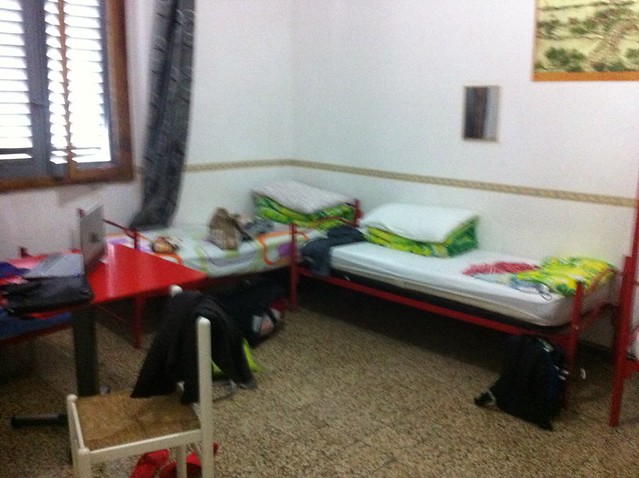
Dorm beds in hostel

What does a Chinese-run hostel look like?

First off, it’s usually in an apartment with rooms boarded up to make smaller rooms or in the case of dorm rooms, a large room with a few beds pushed against the wall.

The Florence hostel I stayed at had 3 large rooms with multiple beds and a smaller room with a double bed. One of the large rooms was used as a dorm room while the other 2 were rented out as doubles for couples.

There is a kitchen/dining room where everyone has their breakfast.

If you are lucky, there are more than one toilets/bathroom. If you aren’t lucky (like me in Florence), there is only one bathroom/toilet.

I had to share that one toilet/bathroom with 13 other people on the busiest day in Florence but it wasn’t too bad because everyone was polite about doing their business quickly.

What I like about a Chinese-run hostel is that the guests are less random people: everyone is Chinese (either from China, Taiwan or less likely Malaysia). Since we share a common language, things get friendlier easier.

The dorm owners are usually very generous about travel tips in their cities. The lady in Florence took us out for a walking tour of Florence while the lady in Barcelona had a notebook filled with travel tips.

The people you meet at a Chinese hostel in Europe

The people I’ve met at the hostels were usually from China.

A lot of them were students studying in other parts of Europe, taking time off for a weekend holiday at a nearby European city.

Most of these Chinese kids are spoiled.

Two of the people I met in Florence were studying in Switzerland. They took the train down to Italy the night before and came to Florence to “do some branded goods shopping”. The transport for each of them were 300 euro for a return trip but it wasn’t much of a problem for them.

But I did meet one not spoiled Chinese student who was studying in France and was visiting Florence.

In Florence, I also met a newly wedded couple from Taiwan who were more rational beings. I’m thinking it’s a combination of being Taiwanese and being adults that made them so much more pleasant than university kids. (I sound like a cranky old lady.)

I’ve only stayed at Chinese hostels run by ladies from mainland China. I’ve read about those run by Taiwanese families but not stayed there before.

I never sat down and asked the ladies why they decided to leave their country and come to Europe. And if running a hostel was their ambition when they left home. I feel that it’s too personal to ask such questions, although they do make good stories.

Food at a Chinese hostel in Europe

The Chinese hostels usually provide breakfast. The food is likely mainland Chinese-styled breakfast with buns and noodles as dishes. I did eat a seafood paella once in Barcelona.

For some extra euros, the hostel owners would prepare an extra serving of dinner for you. The food is still Chinese.

In Florence, I got the chance to eat dumplings–something I haven’t seen for a whole month. The filling of the dumpling was odd though, there was glass noodles and some vegetable with soy sauce. (I like dumplings with juicy meat fillings the best).

Chinese dumplings for dinner

Other dishes include stir fry dishes such as this. On the upper right is Chinese-style pork knuckles. They are divine!
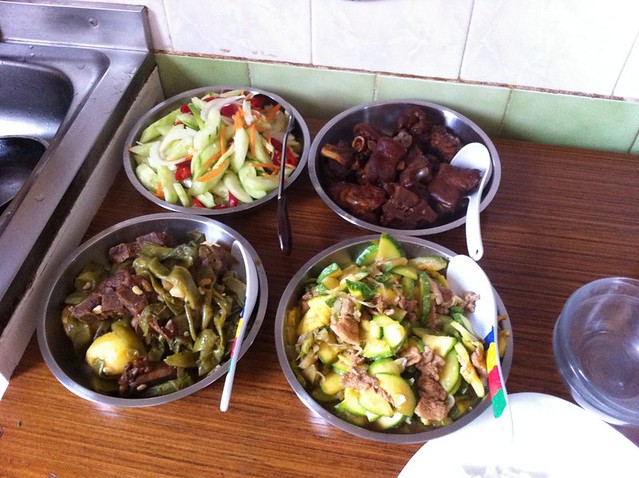
Sides to go with porridge

Would I stay in a Chinese-run hostel again?

It would depend on the price and the country.

For example in Athens, there was a Chinese hostel advertising on online forums. However, the price for a dorm bed was exactly what I paid for a single room.

In Rome, I e-mailed a Chinese hostel to ask about their bed prices. The hostel didn’t have any dorm beds left and only had a 60 euro private room. I decided to opt for an AirBnb room instead.

I do like Chinese-run dorm better than international ones because I get anxious interacting with too many people. In a Chinese dorm, the number of people is limited to the rooms they have, which makes it easier to interact since there’s not as many people around.

Greece day 3: New Acropolis Museum and Rick Steve’s walking tour [YQrtw Day 40 May 17]

I was planning to laze around and visit the New Acropolis Museum later in the afternoon. But when I checked my notes, I found out that the museum closes at 15:00.

I guess that means lazing around will have to come later. [I just looked at my notes again and realized that I confused National Archaeological Museum with Acropolis Museum’s time.]

I first knew of the New Acropolis Museum when D e-mailed me on June 15, 2009, an article about the museum’s opening. I was in my 9th month at work and my reply to the e-mail was:

wow.
I’ve actually forgotten that I want to go to Greece one day.

Then D reminded me that we shouldn’t become work drones. So I put the Acropolis Museum into my mental list of Places To-Go and thought about Greece again.

The Acropolis Museum

When I got to the museum, I thought to myself: I AM FINALLY HERE! (Oh wait, I think I did that at the Parthenon yesterday.)

The museum’s entrance had a surprise waiting. Parts of the floor was clear (with white polka dots), allowing visitors to see the excavation site underneath. There was also an excavated site that was open air and silly people tossed coins into it.

Before the Acropolis Museum's entrance
Before the Acropolis Museum’s entrance

The entrance to the museum was only 6 euro. It was so much cheaper than the other places I’ve been in Italy. I love Greece very much just for this.

Photo taking wasn’t allowed in the museum. I didn’t do any sketches like I did with David but I did sneak photos of the non-exhibits.

Athena guides children in the museum.

There were several of these signs saying “A Day at the Acropolis Museum with the Goddess Athena”. It was the cutest thing I’ve seen in a museum.

The description was in kid-language and was more fun to read than the adult-language sign.

Clear floor of the Acropolis Museum

The nightshift staff at my hotel, Hellen, warned me about the museum’s see-through floors so I wore pants to the place.

At one section, you can see the museum people cleaning up some of the statues. On the same level, the laser cleaning is covered up with a curtain.

View of Parthenon from the Acropolis Museum

On the third floor of the Acropolis Museum is a segment dedicated to the Parthenon. That floor is specially designed to face the same direction as the Parthenon is facing. It also has steel columns in between the carvings to show how the items look like in the temple.

I felt that the museum was a little small since it didn’t take me much time to finish all the items on display.

Still, it was a good museum because of all the Parthenon carvings and Athena statues.

Lunch at Smile Cafe Restaurant

I didn't eat the dog. Honestly.
I didn’t eat the dog. Honestly.

I had lunch at a tourist restaurant. Why is it touristy? Because it prints out maps of the Acropolis area and invites tourists to eat there.

The food was good for a tourist restaurant. I ordered from the Crisis Menu, a set lunch for only 7.50 euro.

I finally had tasty bread (which I never had in Italy). The cheese in the Greek salad was nice. I ate the tomatos and some cucumbers of the salad, thankful that it wasn’t the regular raw vegetable.

The gyros with pork was lovely, although I thought that I should stop eating Middle Eastern cuisine and be more adventurous.

It began raining while I was eating. Thank goodness I have my umbrella with me. I dropped by a coffee place for a 1 euro cafe latte before setting off to find the travel agency that sells bus tickets to Istanbul.

Silver Star Travel was easy to find, thanks to Google Maps. The 14-hour bus ride from Athens to Istanbul cost 60 euro (or 56 euro after -ahem- student discount). The price is half of flying to Istanbul and the time spent is half of taking connecting ferries.

Since my missions for the day was accomplished, I had to find something to do.

As usual, I hopped on a random bus that took me to a random place. And I took a not-so-random bus back to the city center.

Rick Steve’s audio tour

Rick Steve has an audio tour for Athens city so I decided to spend the afternoon walking around with my headphones in my ear.

His audio tours are really awesome. I went into different nooks and crannies of Athens. Climbed steep hills. Passed pretty Mediterranean houses. And learned more about the city than I would wandering aimlessly.

Overexposed Model in Greece

When the tour ended, so did my day. I bought 1kg each of cherries and strawberries (what was I thinking!) before heading back to the hotel to rest and write.

Until tomorrow!

Greece day 2: Athen’s National Archaeological Museum + Acropolis [YQrtw Day 39 May 16]

Corridor of Athena statues at National Archaeology Museum

Location: Athens, Greece

King Agamemnon's mask
King Agamemnon’s mask (not really his though)

Since I am staying 7 nights in Athens, I have 6-full days for sightseeing in the city. I had planned to slow down my pace and visit only one museum/ site a day.

Today’s plan was to see the National Archaeological Museum which is near by hotel and roam around the city in the afternoon.

When I went out a little before 8:30am, the sky was grey and cloudy and the temperature was cool. It felt like my kind of day.

Using directions by Google Maps, I took bus B12.

The signs for buses here in Athens is all Greek so I don’t think the government recommends tourists to take the bus.

Before the museum, there was a little cafe and the price of its bread was very reasonable. I had a pastry with cheese filling and a cappuccino.

While eating, a little tanned girl with messy hair came into the cafe to ask for money. It was rather awkward for me and I focused on my bread.

I didn’t want to encourage begging and thought that it was better than her going out and pickpocket. Actually,  begging is not any better than stealing.

National Archaeological Museum’s goodies

The museum was large but not overly gigantic like the Vatican Museum.

My Rick Steve’s audio guide for the museum worked perfectly, telling me highlights of the museum and the history behind them.

In fact, I had been enjoying Rick Steve’s audio tours for all the places I’ve been. I highly recommend you to download them if you are heading to Europe. He has mobile apps as well as podcasts and they area all free.

While the museum had lots of great Greecian works (like the gold mask above), my favorite section was the little corridor with statues of Athena.

Corridor filled with Athenas

At the end of the corridor was a small statues of Athena, her helmet decorated with winged beings, her Peter Pan collar decorated with snakes (!) and her shield also decorated with a snake. This was a miniature copy of the gigantic Athena statues that stood in the Parthenon in the ancient time (a replica in Nashville shows the size of Athena).

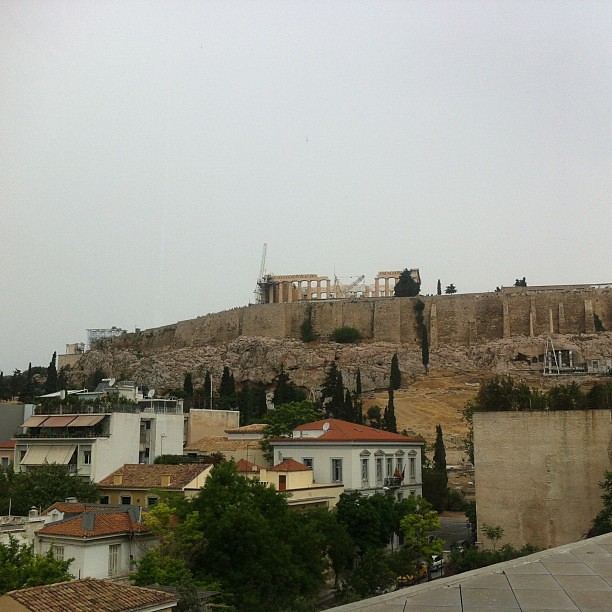
After the museum, I was thinking of where next to go. The sky was still grey and cloudy so I thought it would be perfect to go to the Acropolis and enjoy a not sweaty climb.

Off I went to the metro, buying a frappe to drink along the way. This time, the frappe had a less sour endnote. I’m getting to like this more and more.

Acropolis

It was about 12 noon when I reached. Based on my experience at the Vatican Museum, this was the best time to visit any famous sites as the tour groups have headed for lunch.

I got my tickets at the Theater of Dionysus so there wasn’t a queue. Even with the ticket, I had to exchange for an electronic ticket at the main entrance so it kind of annoyed me.

Rick Steve’s Acropolis audio tour kept me company the whole way. This is way cheaper than hiring a tour guide and less taxing!

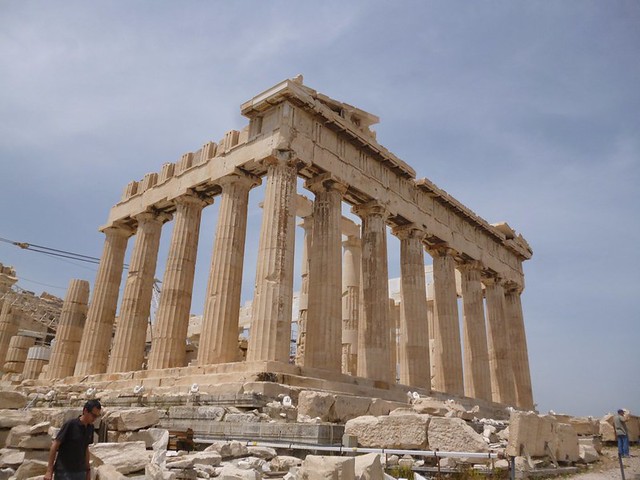
Pathenon being refurbished

The path to the Parthenon wasn’t a smooth walkway and I was thankful that my sandals didn’t sprain my feet.

Oh, I forgot to mention, the sun decided to come ot and play when I bought the ticket. The sky was cloudy but the ray of the sun pierced through and made it a little too warm.

Prettier side of the Parthenon

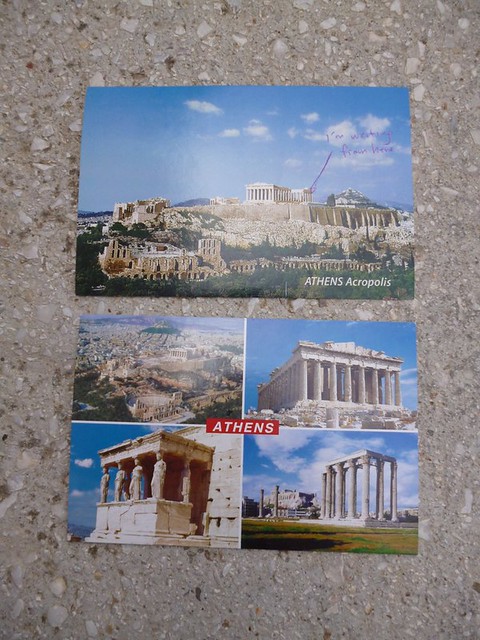
It got so hot that I had to hide in the shade, thinking if I should wait for sunset and leave at 8pm (it was 2pm then). I didn’t leave that late but I did hang around in the shade, writing postcards.

Postage in Greece is cheaper than in Italy. I had to pay 2 euro to mail a postcard from the Vatican City but here in Greece, it was only 78 cents each.

Postcards from Athens

Oh, I also started eating a chocolate pastry I bought. I was told by someone working at the Acropolis that only water is allowed. Oops.

After my long wait, I finally finished my audio tour and descended from the holy hill.

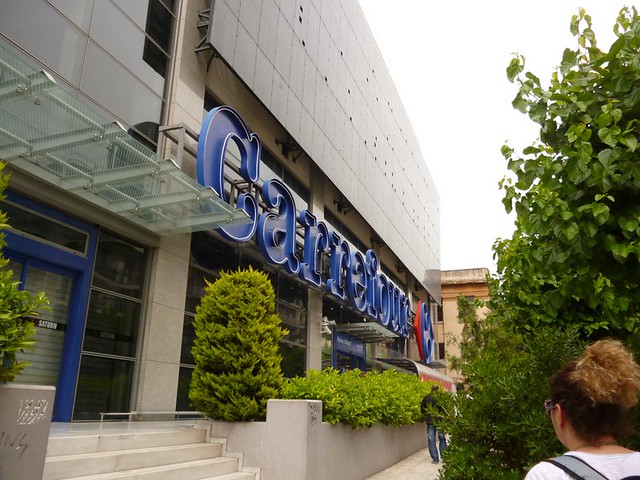
My phone’s battery was dangerously low then so I decided to head back to the hotel. Before that, I stopped at Carrefour (!!!) for some dairy product to prevent my stomach from having severe gastric.

Carrefour in Athens near Larissis Station

I did plan to head out later but my lazy bones decided to stay in with my computer. Let’s hope tomorrow’s more productive!

Italy day 5: Ufizzi Gallery and how my shoes ate my feet in Florence [YQrtw Day 31 May 8]

Galileo's finger

Location: Florence, Italy

[I am writing this slightly tipsy from a 3.60 euro bottle of Italian sparkling wine. Hangovers await me.]

The morning was dedicated to the Ufizzi Gallery. The art museum is described as “one of the oldest and most famous art museums of the Western world” by our go-to resource, Wikipedia.

I was planning to take the light rail from the hostel to the train station to save my feet from too much walking but I found out that I would still need to walk if I take the train and that the travel time would be the same.

In the end, I walked to the gallery with the Taiwanese newlywed and a Chinese couple who came yesterday. The journey to the gallery is a 2km walk but with my crazy shoes, it felt like I was walking in hot coals.

I wore the 5 euro fake leather, made-in-China shoes I bought yesterday at Florence’s Tuesday market. I knew I should not wear new shoes when I need to walk but I convinced myself that I will never be able to wear it anytime during the trip anyway.

The shoes were narrow at the toes after I wore my socks. The sole was a terrible rubber that was a far cry from my darling Crocs. I had a few blisters at the end of the day.

When we got to the Ufizzi at around 8:30am, the line to queue for tickets didn’t seem very long. As I have the Firenze Card (72-hour museum pass), I could skip the lines and go straight in.

I got to the second floor (4 long flights of stairs) before realizing that I could not rent the audioguide there. It was another 4-flights down and 4-flights up before I got to start my tour.

Besides the gallery’s official audio tour (6 euros), I also brought along Rick Steve’s audio guide for Ufizzi. I had to juggle using both audio guides during the visit but it was quite worth it.

The museum was packed with great works. It took me about an hour to finish the very crammed first seven rooms.

I particularly loved the Botticelli room because all his female figures are gorgeous. Leonardo da Vinci’s helping hand in the Baptism of Christ, when he was an apprentice, is lovely. Leonardo drew the angels on the left.

No photos were allowed in the Ufizzi and I didn’t even bothered sneaking any photo. I did see many people not-so-secretly snap pictures.

By the time I was done, it was almost 12:30pm. I dropped into the Galileo Museum right next door since it was covered by the Firenze Card.

In the Galileo Museum, the most impressive things were Galileo’s fingers and the terracotta model of fetuses in difficult delivery conditions.

Galileo's finger
Galileo’s finger

Lunch time in Florence

After the museum, my feet were hurting really badly but I still had to drag myself around.
I stopped by tourist restaurant famous for its Florentine steak but ordered the cheaper lunch menu.

Lunch was lasagna and roast chicken. The lasagna was creamy and thick while the roast chicken pale but well-seasoned.

The bad thing about dining out in Italy is that they don’t serve tap water. Instead, they serve sparkling or still water at cheapest 1 euro a pitcher.

After lunch, I had another awesome cafe latte at the pastry store near Duomo.

The next part of the day was filled with a lot of aimless walking. Correction, I was trying to find obscure museums but my Google Map and physical map and internal map wasn’t coordinating.

Even when found sites with signs of Museo XXX, there wasn’t a counter in sight or the counter person said to come back another time. The mystical Italian business hour at work, I suppose.

I ended up visiting only the Opera del Duomo Museum to hide from the rain and to use the bathroom. In Italy, public restrooms can cost 1 euro a go or 50 cents at the nice coffee shop I like.

The greatest piece in Opera del Duomo was the restored Gate of Paradise. The golden panels were too small and high up so I didn’t really give it a good look.

Afterwards, I was hoping to visit another museum before I call it a day. Thanks to my terrible map skills, I ended up in a library with a nice courtyard. That wasn’t where I wanted to be but I spent about 10 minutes trying to read my book.

In the end, I decided to use Rick Steve’s Renaissance Florence tour but I walked in the opposite direction of its starting point.

I did go to one of the points in the audio tour so I stayed there and listened to the file all the way until Piazza della Signoria. Then I followed the audio guide right till the end. It began to drizzle halfway during the tour.
Since I was at the opposite bank, I walked in the drizzle for the cheap gelato. I picked chocolate chip and coffee in a cup. The gelato melted a little while I walked.
From the gelateria onwards, I gave up on humility and took off my shoes. I walked part of the journey with only my socks and a major part of my journey using my shoes as sandals.
When I got back, I realized that a huge blister formed on my toe and even on the soles of my feet where the skin is deep. Why!!

Review: How to take a career break to travel [e-guide]

How to Take a Career Break to TravelHow to Take a Career Break to Travel

I’ve done a few reviews of books on travelling but all of them were published traditionally (meaning you can buy them from bookstores.)

Today’s book is a little different. It’s an e-book by Alexis Grant called “How to take a career break to travel“.

If you are not following Alexis yet, you must. She givesgreat, free tips about how to create the life you want.

Let’s get back to the review, Alexis wrote the e-book “How to take a career break to travel” after her solo backpacking trip to Africa. I’ve been meaning to get it since I first saw it but waited until a rare 50% sale to buy it.

After reading it, I immediately bought the rest of her e-books which were also on sale.

Before I bought the book, I’ve already bought tickets for my round the world trip so I didn’t buy it to convince myself to travel.

I wanted to find out what tips she had based on her experience.

I wasn’t disappointed.

How to take a career break to travel

PS This is an affiliate link. I get some portions of the sale if you buy it.

How the book was helpful

Most of the travel blogs (or even books) on travelling seem to focus on long-term travel or making travel a permanent part of your life. Alexis’s book is more practical for those who want to get back into the workforce after a long trip.

For those who need to be convinced that they can and should take a career break to travel, the book has a whole section on the Four Big Buts. It tells you what to do about money, housing, family and job.

There are also tips for those still in the planning mode

  • whether to keep a travel blog
  • how to decide where to go
  • being committed
  • getting support

Besides that, you can find out what sort of logistics planning you need to make. The last part is about how to get back to normal life after travelling.

Have a mission

The biggest lesson I got from the book is to have a mission when travelling.

I’ve seen too many backpackers or RTWers whose sole mission is to enjoy themselves (a very good goal but not very helpful for long-term career plans).

Alexis’s mission when she was travelling was to write an article each month. For me, I want to continue maintaining my blog while I travel. Maybe I can branch out to something even bigger than just a blog. [I’m failing a bit now that I’m about a month into the trip.]

The only problem I had with the book is that it’s only in PDF. I converted it into mobi for my Kindle but the formatting is a bit wacky. In the end, I printed it out in paper.

If you are thinking about getting a copy of her book, check out the page for  How to Take a Career Break to Travel. [This is an affiliate link. I get some portions of the sale if you buy the book.]

PS If you are as frugal as me, I suggest you wait till Alexis has a big sale before buying it. I’ll update on my Facebook page when she does.

Singapore for museum lovers (Part 2)

Bukit Chandu

Welcome to part 2 of Singapore for museum lovers. Last week I shared what I thought about the Asian Civilisation Museum, National Museum of Singapore, Singapore Art Museum and Peranakan Museum.

Today, I’ll be talking about three less visited museums: Reflections at Bukit Chandu, Memories at Ford Factory and Singapore Philatelic Museum.

The first two museums are dedicated to World War II so if you are a WWII fan, be sure to check those places out. The only down side about these two museums is that they are really far from other sights. Bummer.

Memories at Ford Factory

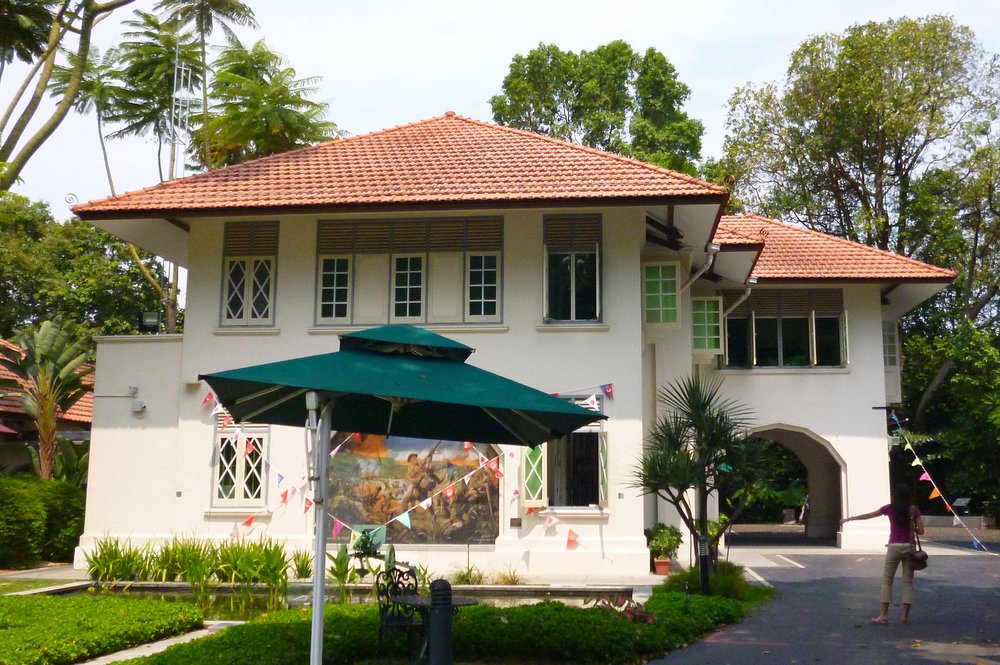
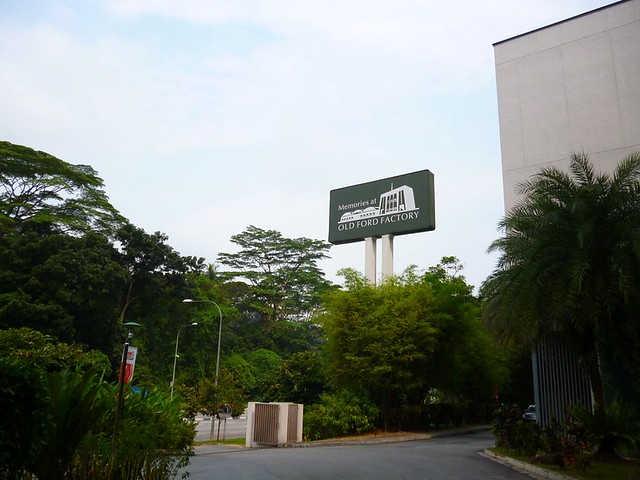
Memories at Old Ford Factory

Out of the three museums I will be talking about today, Memories at Old Ford Factory is my favorite. In its past life, the museum was the Old Ford  Motor Factory. I became interested in it because there were rumors that the place is haunted.

The museum was the location where the British signed its surrender contract (?) to the Japanese. The room where the signing is part of the museum collection. You can stand behind glass wall to see the room.

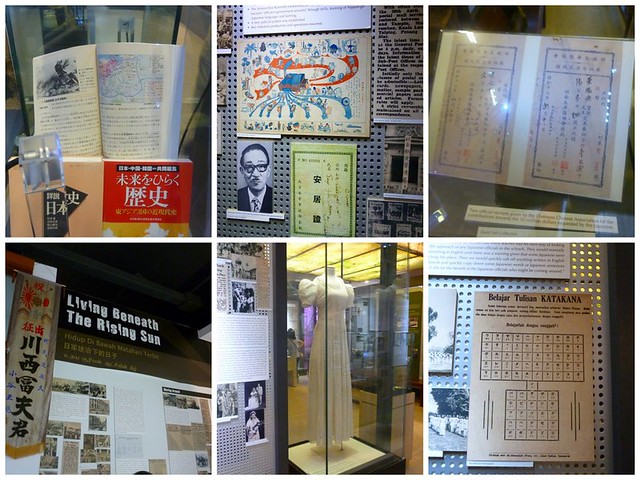
What I like the most about this museum is that it’s not full of artifacts (even though I do love reading). Instead, it has transcription of people telling their experience of what happened during the days of the Japanese occupation. [Or as the website says: “first-hand oral history accounts, archival records and primary documents”.]

Memories at Old Ford Factory

There’s also a theatrette at the museum (same as at Reflections at Bukit Chandu) and the film made me shed tears.

I like this museum a lot but just thinking about getting there gives me a headache. There are public buses to the museum but it’s pretty much in the middle of nowhere. If you do not have a lot of time in Singapore, I think you should skip this place.

Nitty gritty: Memories at Old Ford Factory
Website: http://moff.nas.sg/moff/public/html/
Where: 351 Upper Bukit Timah Road, Singapore 588192
Opening hours: Mondays to Saturdays, 9.00am to 5.30pm; Sundays, 12.00pm to 5.30pm
Entrance: S$3 for adults

Reflections of Bukit Chandu

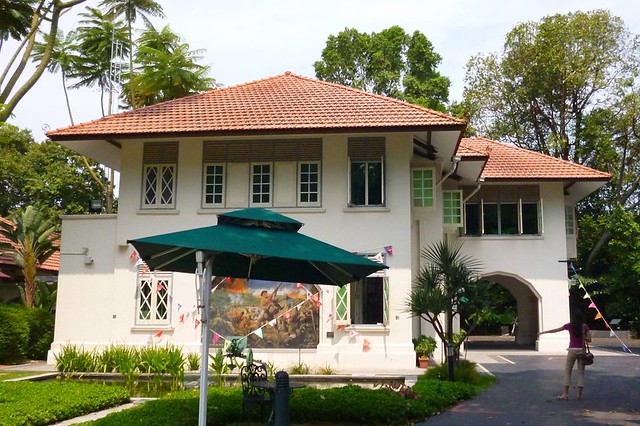
Reflections at Bukit Chandu

Another museum focused on World War II. This time, it’s more about how the Malay community help defend Singapore against the Japanese army.

The museum is located at the top of Bukit Chandu (or Opium Hill). If you are walking, be prepared for the very hilly walk from the Pasir Panjang MRT station. On breezy days, it’s very relaxing to walk uphill since most of the route is shaded.

The museum is very small. A old mansion “close to the former battle site – the Battle of Pasir Panjang, where 1,400 brave soldiers from the Malay Regiment heroically defended the last stand against a 13,000-strong Japanese army”.

The best part about this museum is the little theater where they have great sound and light effects to show how it was like when the Japanese invaded. Be prepared to shed plenty of tears (more tears than Old Ford Factory).

Reflections at Bukit Chandu

The museum was different from the rest since it focused a lot on how the Malay Regiment defended Singapore. In other museums, it seemed like it was mostly the British work (and terrible work at that).

It’s also rather interesting since in the Peninsula Malaysia, Malay gave their bicycles to the Japanese army, giving them a chance to reach Singapore from a direction that wasn’t expected by the British.

One of the artifacts of the museum is drawings by a local Chinese who survived the war. It showed how cruel the Japanese soldiers were during the period.

A large part of the museum is dedicated to Lieutenant Adnan bin Saidi who was portrayed as a hero who never gave up. Honestly, I haven’t heard of Lieutenant Adnan until the visit, I hope he would be upgraded to the position of national hero in other places and not just this museum.

More photos and detail of Reflections at Bukit Chandu can be found at remembersingapore blog.

Nitty gritty: Reflections at Bukit Chandu
Website: http://www.nhb.gov.sg/NHBPortal/Museums/ReflectionsatBukitChandu
Where: 31-K Pepys Road S(118458)
Opening hours: Close on Mondays (except public holidays) Tuesdays to Saturdays, 9.00am to 5.00pm
Entrance: S$2 for adults

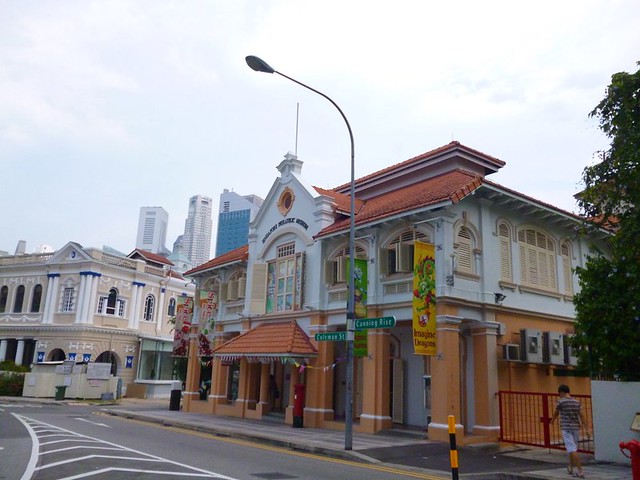
Singapore Philatelic Museum

Singapore Philatelic Museum

I’ve collected stamps when I was in primary school. The only reason I did it was because in the books I read, stamp collecting was a good hobby. The books never told me that watching TV, playing video games or reading can be considered hobbies.

My mom was writing to my grandfather back in Taiwan so we had many pretty stamps with the words “Republic of China”. I never knew then why they didn’t just write Taiwan but I accepted it and filed it in my stamp book.

But I’ve never really liked stamp collecting. It was most boring to me since the stamps just sat there and did nothing. At least books told me stories and running around makes my heart beat faster. I pretty much gave up stamp collecting when I was older.

Oh, where was I? Ah, the Singapore Philatelic Museum. The reason I gave a short history of my liaison with stamps is to tell you that I really do not like stamp collecting.

My introduction of the Singapore Philatelic Museum will be marred by my experience with stamp collecting.

Singapore Philatelic Museum

I visited the museum as part of the Free Museum Entrance Month. My head was already full of other exhibits in the other museums so the exhibition at the stamp museum was rather disappointing.

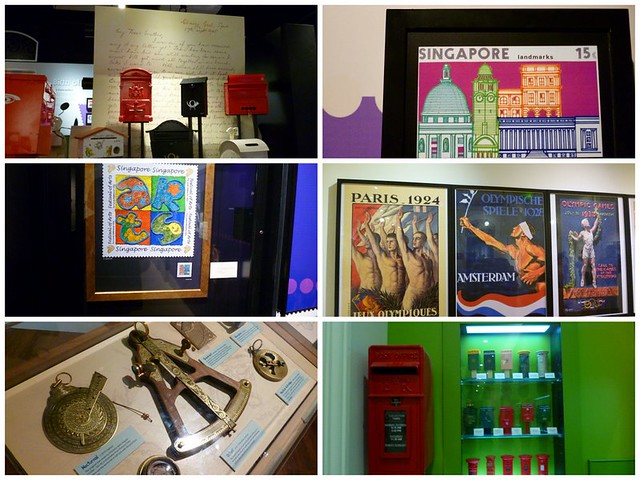
There is a room on how stamps are made. To me, a room showing how cookies are made is a lot more interesting.

There are blown up stamps for different occasions. I saw the Olympic Games stamp when I was there.

Surprisingly, there is a room about different cultures in Singapore. They must have ran out of stamp-related artifacts.

I was quite bored out of my mind at the museum. So I will stop here.

Nitty gritty: Singapore Philatelic Museum
Website: http://www.spm.org.sg/
Where:  23-B Coleman Street S(179807)
Opening hours: Mondays 1.00pm to 7.00pm; Tuesdays to Saturdays, 9.00am to 5.00pm
Entrance: S$6 for adults  (Seriously? I would rather take a bus to Old Ford Factory than pay this price for entrance.)

Have you been to the three museums I talked about? How was your experience?

Singapore for museum lovers

museums.com.sg

I adore museums. There’s something about having pieces of art/culture/history arranged neatly in a central location with captions that makes me go weak in the knees. That, plus air conditioning during hot days.

I had the chance to visit 7 national museums (including one that is not listed as a museum) in Singapore last August.

I want to share my very biased list of which museums to go to (or miss).

Best museum in Singapore:
— Asian Civilization Museum

Best for general knowledge of Singapore:
— Singapore National Museum

Best for kitsch:
— Peranakan Museum

Do not go:
— Singapore Philatelic Museum

For WW2 history buffs:
— Singapore National Museum
— Reflections at Bukit Chandu
— Memories at Ford Factory

For art lovers:
— Asian Civilization Museum
— Singapore Art Museum

One museum to visit if you only have 1 hour
— Peranakan Museum

PS I have not included the Art Science Museum in the list because I’ve not been there. The entrance price S$28 (US$22.6) is just too expensive. Even the Lourve doesn’t charge as much €15 (US$19.8).

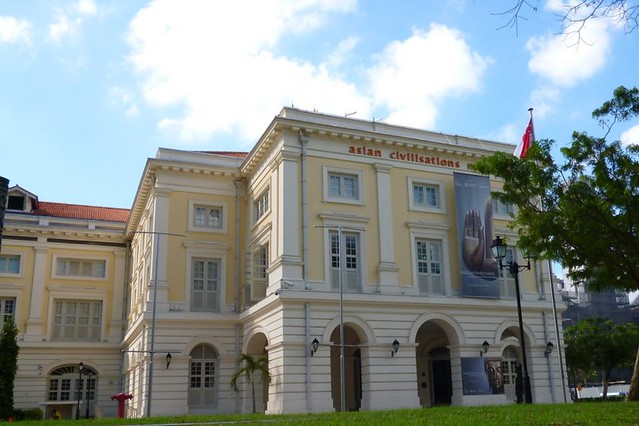
Asian Civilisation Museum

Asian Civilisation Museum

The best museum in Singapore in many of my friends’ opinion. Why? Because the collection is the best among the museums around here.

The collection features items from many parts of Asia. I particularly like the part on China and the ghosts guardians.

The museum is near the Esplanade and the Merlion. So if you’re around the area, drop by ACM.

It’s best to allocate about 1.5 hours.

Nitty gritty:
Website: http://www.acm.org.sg
Opening hours: Monday 1pm- 7pm; Tuesday-Sunday 9am-7pm (to 9pm on Fridays)
Entrance fee: S$8 (Discounted admission on Fridays, 7pm – 9pm)

National Museum of Singapore

If you want a good look at this museum, you’ll need at least 2 hours for the permanent exhibition on Singapore’s history. There are two routes on the audioguide: story telling and history telling. I like the story telling since it’s very different from how other museums show their collection.

If you have an hour, the collection upstairs about Singapore’s food, fashion, film and photography is a good place to kill time.

The travelling exhibitions are usually top-notch. I loved the Pompeii exhibition and the Museum of Orsay collection.

Nitty gritty:
Website: http://www.nationalmuseum.sg/
Address: 93 Stamford Road S(178897)
Opening hours:
Singapore History Gallery 10am to 6pm, Daily
Singapore Living Galleries 10am to 8pm, Daily **Free admission from 6pm to 8pm **Last admission at 7.30pm
Entrance fee: S$10

Singapore Art Museum (SAM)

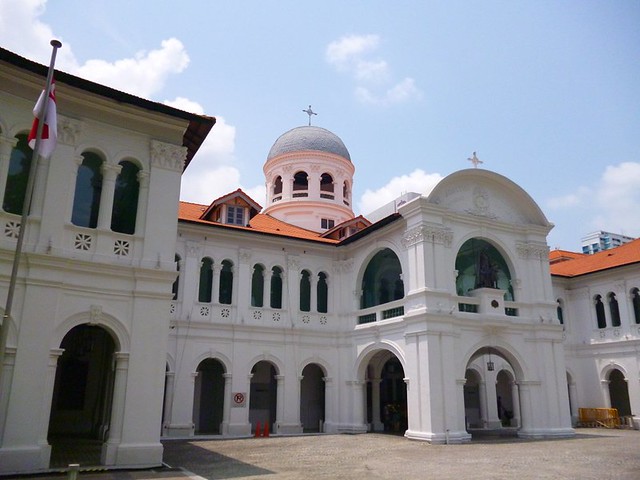
Singapore Art Museum

When I first visited the Singapore Art Museum, it was full of rather boring and depressing art pieces. I regretted paying my entrance fee and swore never to come back.

But I did come back because of the free entrance on Friday night. The art work were better and there were more things being exhibited.

The main building (picture in the photo above) was a boy’s school. It’s rather fun imagining how it would be studying at the school.

The cooler exhibition is at the new “wing” at 8Q, which is just a corner away. Things are more exciting at 8Q.

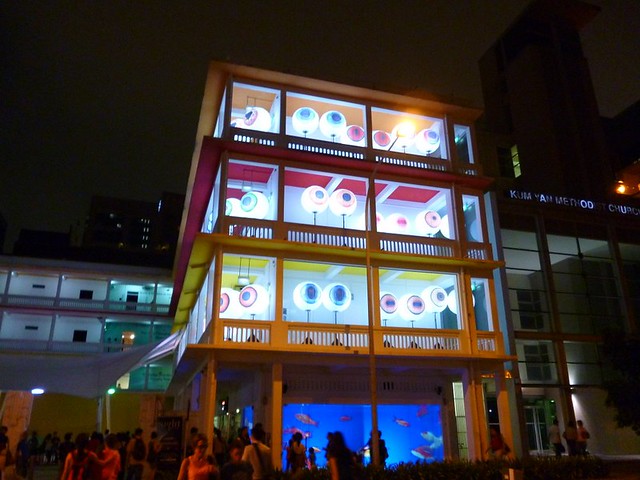
Singapore Art Museum at 8Q

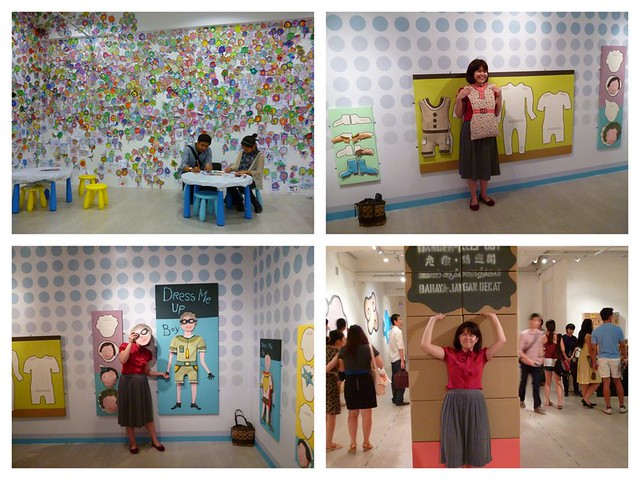
The exhibition at 8Q is more interactive as you should be part of the art pieces. Exhibit A, B, C, D:

Interacting at Singapore Art Museum

Nitty gritty:
Website: http://www.singaporeartmuseum.sg/
Opening hours: Monday-Sunday 10am – 7pm Friday 10am – 9pm (Enjoy complimentary entry on Friday evenings from 6pm – 9pm)
Entrance fee: S$10 (Free entry on Fridays from 7pm – 9pm)

Peranakan Museum

Singapore Peranakan Museum

If you like bursts of colors, the Singapore Peranakan Museum is where you should go. Everything about it is beautiful.

Let me try to explain what Peranakan is. (Or you can click on the link there to head to Wikipedia.) Once upon a time, men sailed from China to what is now known as South-Southeast Asia (yes, I made up that term). The men who settled down here and married local women. The children would grow up in a mix of two cultures–Chinese and local–and thus the Peranakan culture was born.

To be honest, this museum is not my favorite museum in terms of content. It does show you how the daily lives of Peranakan is like with reenacted locations of the house filled with furniture. But somehow, it felt like it was trying to commercialize the concept of “Peranakan”.

Unlike the Pinang Peranakan Museum in Penang, everything in this museum has a little note explaining the scene. That’s a bonus point for the museum, I guess.

Nitty gritty:
Website: http://www.peranakanmuseum.sg/
Opening hours: Monday 1pm to 7pm; Tuesday to Sunday: 9am – 7pm (to 9 pm on Fridays) (50% discount on admission charges on Fridays, 7pm – 9pm)
Entrance fee: S$6 (Free entry on Fridays from 7pm – 9pm)
Asian Civilisations Museum & Peranakan Museum Joint-ticket** S$10

Check out part two where I introduce the lesser visited museums: Singapore Philatelic Museum, Reflections at Bukit Chandu and Memories at Ford Factory.

Review: Kudat Golf & Marina Resort

KUDAT GOLF & MARINA RESORT

I haven’t talked much about my trip to Kudat with mom (except about food) so I’ll start with the hotel we stayed at during our 1 night in Kudat.

While we were planning the trip, mom said we could stay at Kudat Golf & Marina Resort since we’ve not stayed there the last time we were in Kudat. (Summary of the trip 10+ years ago: The whole family was in the north of Sabah to catch the eclipse. We stayed at a hall of a Taoist Temple because all hotels were full.)

I made the booking online and picked the Standard Garden Terrace (Twin-Sharing) room which was RM180.00 nett

While driving, the hotel is not the easiest to find as the sign only pops up once in a while. Our car drove past the golf area on the windy road before we reached the main building.

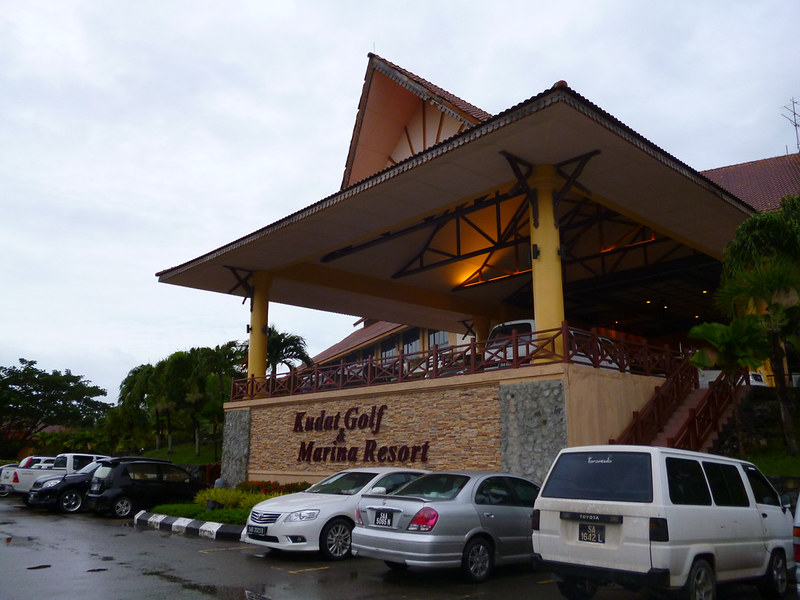
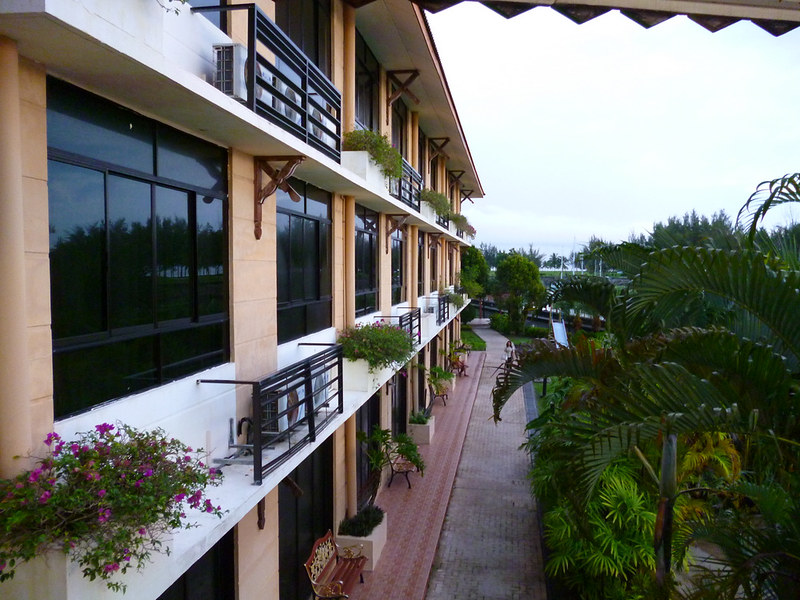
Kudat Golf & Marina Resort facade

I didn’t have much expectations for the hotel, even though it has “Resort” in its name.

Sure enough, it was a small resort with only 3 stories (4 floors of room if you count the ground floor).

Other half wing of Kudat Golf & Marina Resort

Standard Garden Terrace (Twin-Sharing)

Twin room of Kudat Golf & Marina Resort

Our room was located on the ground floor. The glass doors opened to a small pavement and a shrub which covered some of the view of the golf fields.

It wasn’t the most fantastic view but we were either sleeping or watching TV anyway.

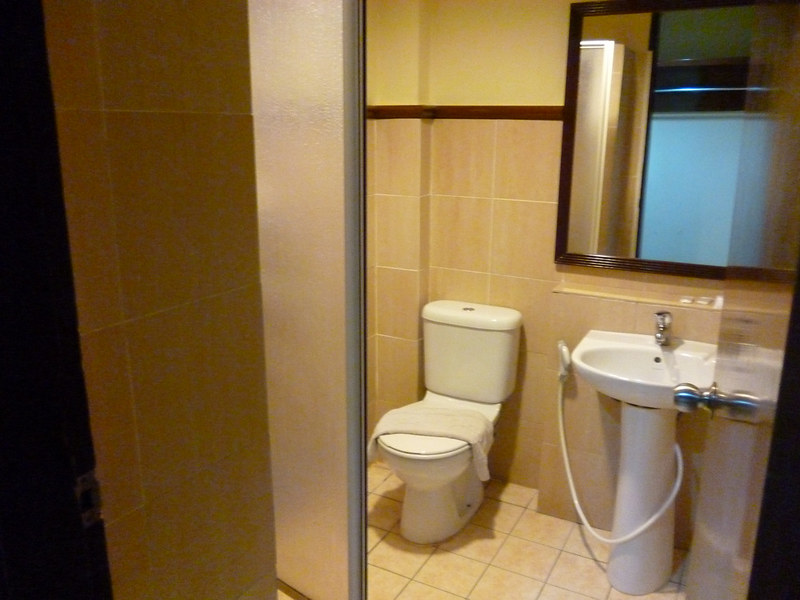
Bathroom of Kudat Golf & Marina Resort
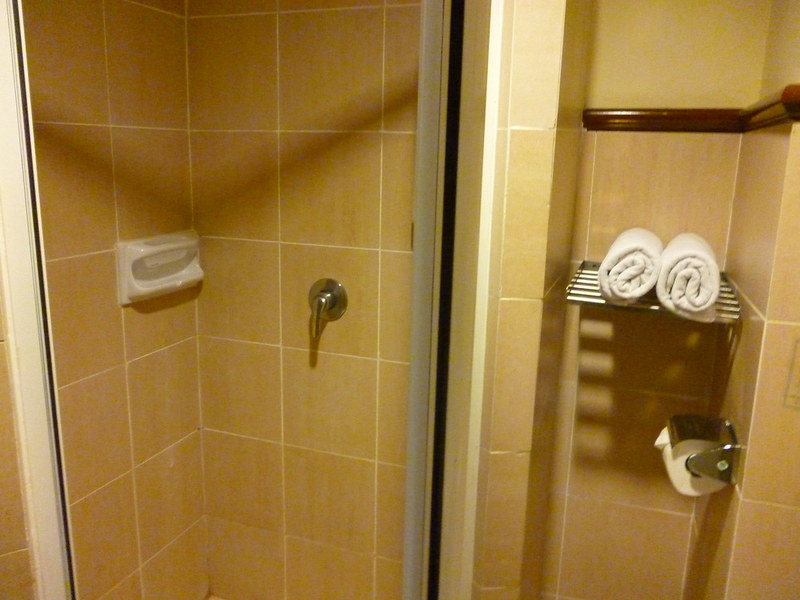
Shower Kudat Golf & Marina Resort

Of course, there was no bathtub. (I adore bathtubs even if it uses too much water.)

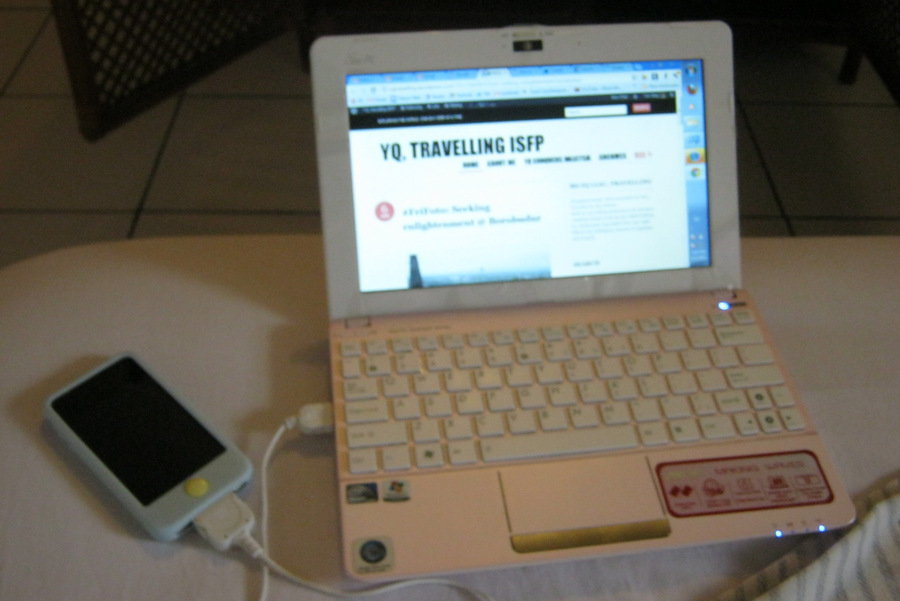
Unfortunately, there wasn’t Wi-Fi in the room. I had to bring my laptop out to the lobby so I could surf the Net. (Why are you online when you are on vacation?!)

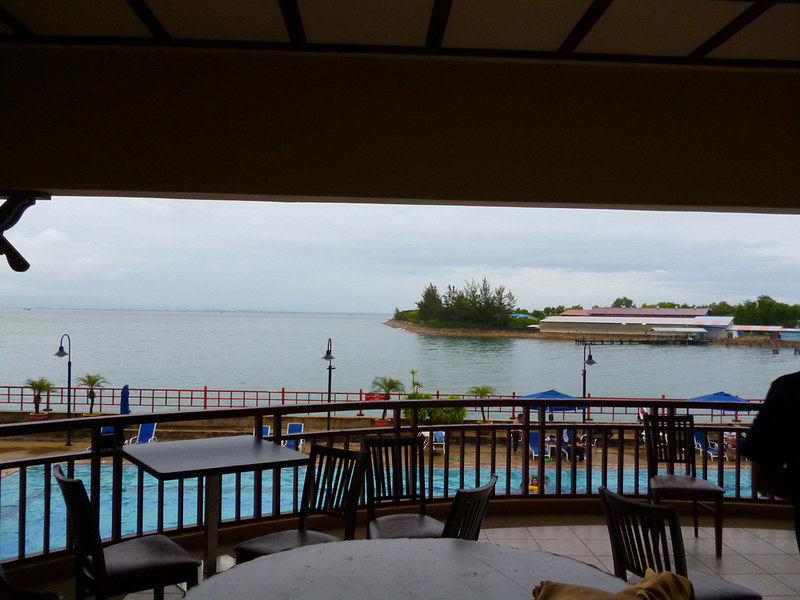
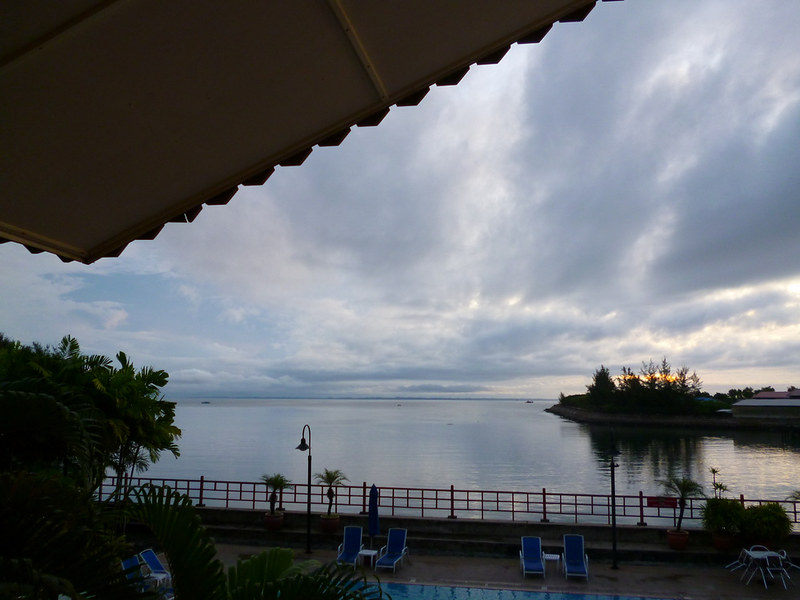
View from the lobby

View from lobby, overlooking swimming pool at Kudat Golf & Marina Resort
View from lobby at Kudat Golf & Marina Resort (again)
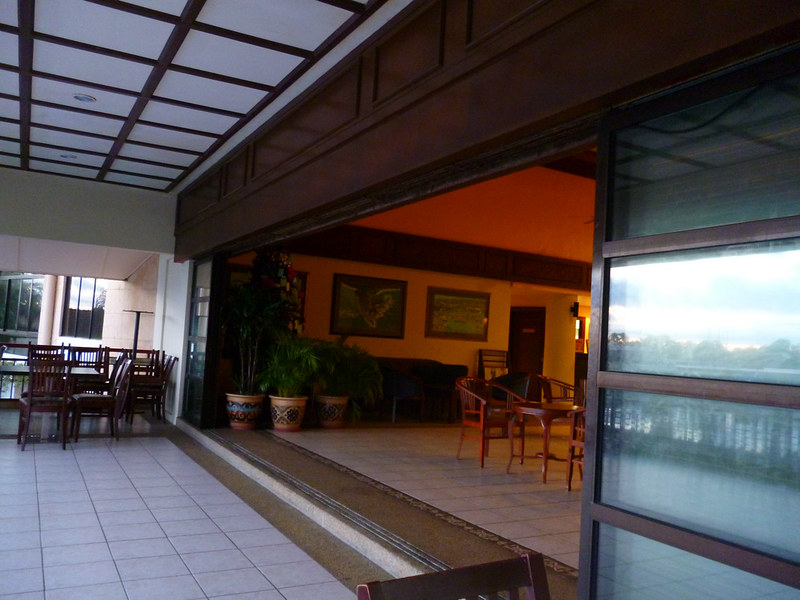
Lobby and veranda of Kudat Golf & Marina Resort

Luckily, the view from the lobby was quite gorgeous.

I even woke up at 5.30 am, hoping I could catch the sunrise.

Unfortunately, a bunch of trees faraway blocked my view of the sun. It was too cloudy for sunrise anyway.

So-so breakfast

As you probably know by now, I adore food.

You probably cannot tell from my stomach that I like to eat because many kind Samaritans have offered me their seats on the train, thinking my food baby is a real foetus.

I digress.

D'Conutt
D’Conutt

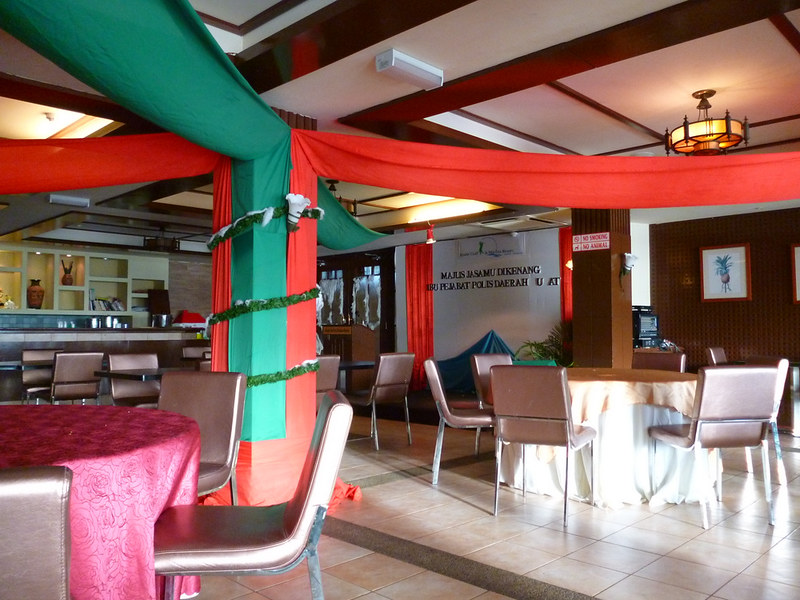
Our room came with free breakfast at the D’Conutt Coffee House at the other end of our corridor.

I have not figured why many Malaysian establishments LOVE to add a “de” or “d'” to their restaurants. Is it to give it a French flair? Why would they need a French sounding–but obviously not French because “d'” comes before a vowel–name?

Anyway, the breakfast was so-so local food although I quite enjoyed the drinks–orange syrup with water and coffee.

Not so yummy breakfast

In a nut shell

Kudat Golf & Marina Resort is a nice pretty place with what you need for more than minimum comfort. You will need a vehicle to get in and out as the public transport to town is not developed.

There are other hotels right inside Kudat town if you wish something more central. (Shops all close really early so it’s not really that convenient anyway.)

Find out more on Kudat Golf & Marina Resort website.

Review: Pontian Garden Hotel

pontian garden hotel

It’s Tuesday and almost mid-week. This week, I will be sharing a post each on Tuesday and Wednesday because they are hotel reviews. I feel it’s kind of cheating when I post hotel reviews so I line two at a go. Enjoy!

Today’s post is about a charming hotel in Pontian, Johor.

If you don’t follow me on Twitter, you might not know that my sister and I had to cancel our plans to Gunung Ledang two weekends before. We missed the train to Sematan Segamat and took a bus to the long distance bus terminal but managed to missed the bus by 2 minutes! (TWO MINUTES!)

It felt like something in the universe was telling us not to go to Gunung Ledang so I cancelled our room reservation with the resort. (Yes, I’m superstitious) We sat in the busy bus terminal with our backpacks and googled the places nearby.

In the end, we decided to go to Pontian because it’s relatively near Johor Bahru. Also because I’ve actually heard of the place. (It’s food famous!)

Since we did not do any research about Pontian, we had to frantically read up links from Google.

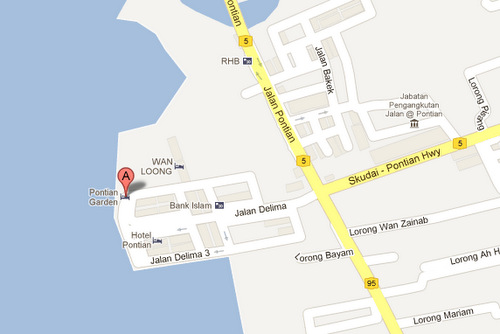
While searching for a place to stay, I discovered Pontian Garden Hotel on Google Maps. I fell in love immediately because it looked like it overlooks the sea.

Pontian Garden Hotel on Google Maps

Pontian Garden Hotel’s strategic location

When we reached the bus terminal, I was delighted to find out from my Google Map app that the hotel is walking distance.

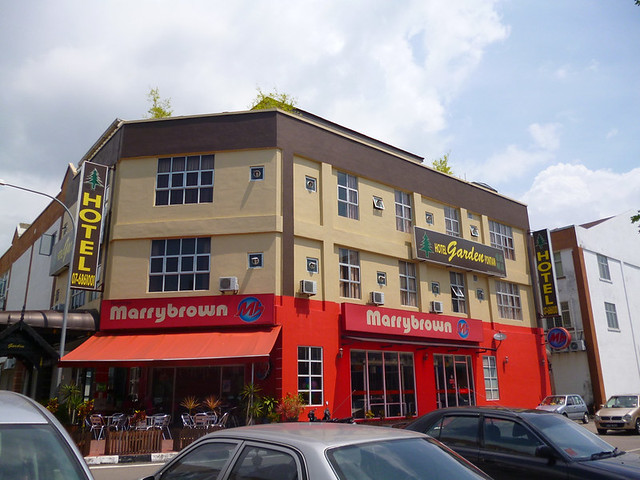
There’s even a Marrybrown under the hotel. I love fried chicken. Too bad we didn’t have any fried chicken during the trip. (Such a tragedy.)

Pointian Garden Hotel

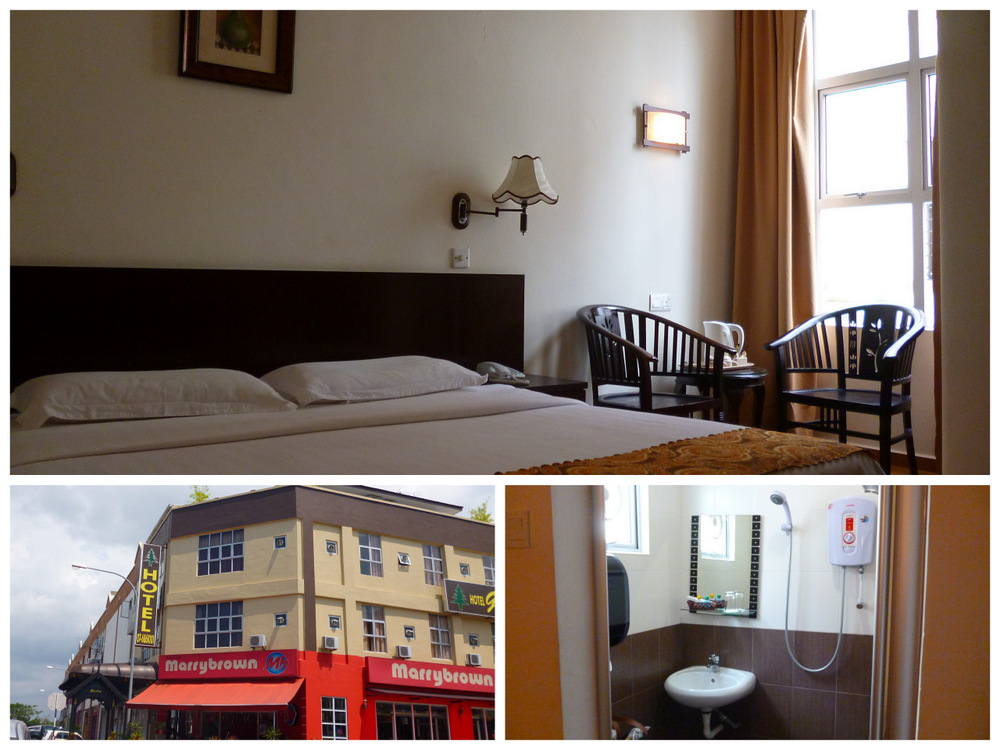
When we checked in, the concierge told us that they only had standard rooms which were RM 118 per night. Good enough!

There was also FREE WI-FI! Password: jiayuanpg1001

Our room was on the second floor and there was no elevator. Thank goodness we have very light backpack.

Pontian Garden Hotel Standard Room

The room was very comfortable as the air-conditioning worked very well.

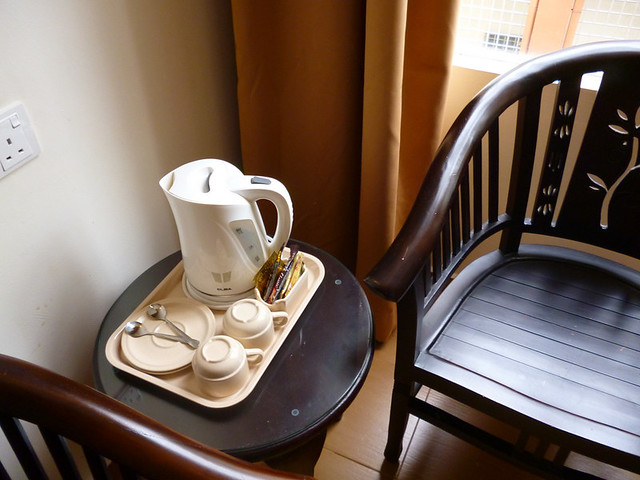
Coffee & Tea set at Pontian Garden Hotel

I also like the coffee and tea set. Free coffee and tea!

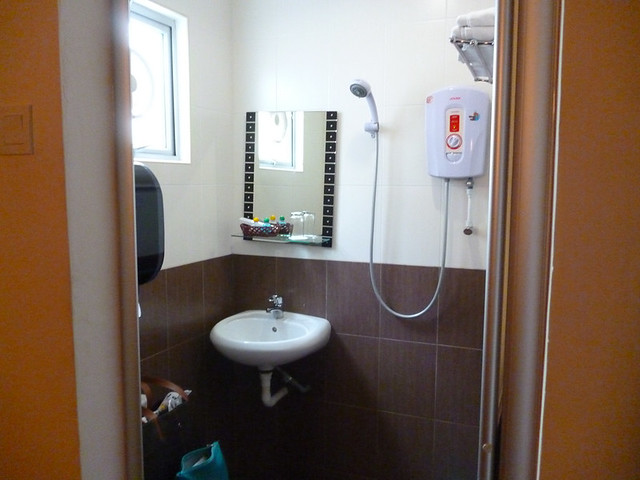
Pontian Garden Hotel shower

The only problem with the room is the shower: The water sprayed almost everywhere. Eeek.

Best about Pontian Garden Hotel

Good points about the hotel include the helpful concierge. They helped us call up a taxi to bring us to Tanjung Piai to see the southern tip of the continent of Asia.

But, the best thing about the hotel is not the room, the people or the breakfast (I love food!).

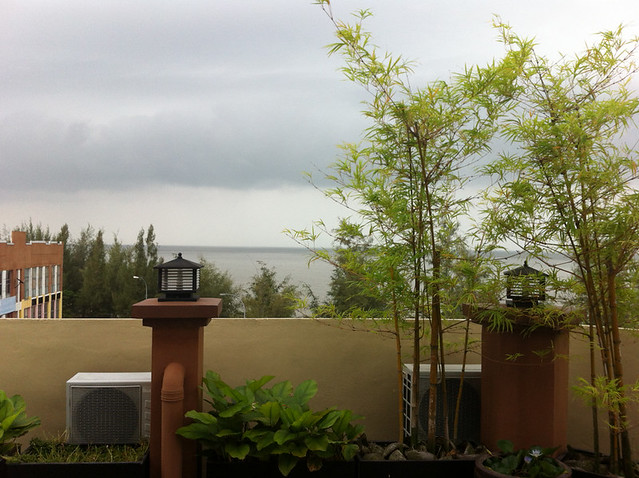
It was the view of the breakfast place. Look!

View of the sea from terrace of Pontian Garden Hotel

Imagine having breakfast while looking at the deep blue sea. (OK, it was gray the day I was there.) The sea breeze is great in helping with invigorating the appetite!

In a nut shell

Pontian Garden Hotel is a fantastic place to stay if you are in Pontian. The price, view, room, people are all fantastic.

Find out more on Pontian Garden Hotel website.

Other Malaysian hotel reviews on YQ Travelling:

Top 5 free digital tools for travel blogging

travel blogging tools

I celebrated my blog’s 1 year birthday early this month. In terms of travel blogging, I’m practically an infant. But I hope to be able to share some of my experience with you.

Today, I will tell you which are my Top 5 favorite free tools for travel blogging. The tools can be adapted to other types of blogging as well.

Since I’m too miserly to buy software for blogging, I choose to use free (not pirated) software for all my work on YQ Travelling.

I’m blogging on the WordPress.com platform so some of the tools might not work for you (eg #5).

Here are the Top 5 free digital tools I use:

  1. Windows Live Writer
  2. Dropbox
  3. Picasa
  4. Evernote
  5. WordPress.com
  6. (Extra) LibreOffice writer

No. 1: Windows Live Writer

Windows Live Writer
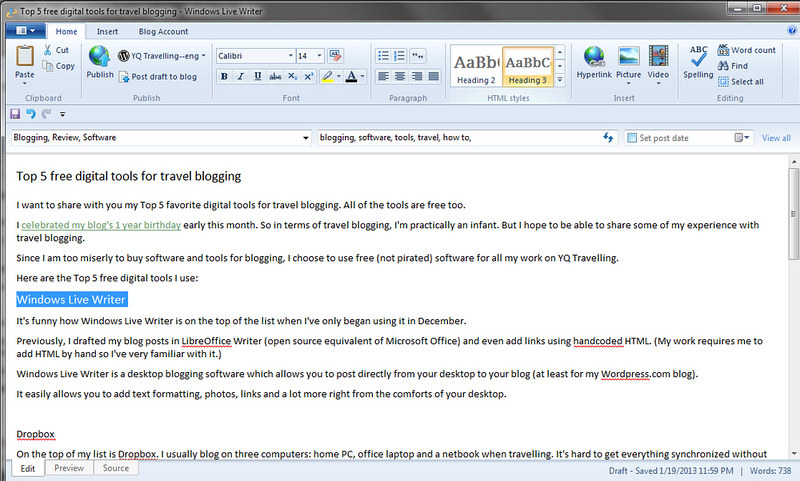
Working on a draft of this post in Windows Live Writer

It’s funny how Windows Live Writer is on the top of the list when I’ve only began using it in December. Windows Live Writer is a desktop blogging software which allows you to easily post directly from your desktop to your blog (at least for my WordPress.com blog).

Previously, I drafted my blog posts in LibreOffice Writer (open source equivalent of Microsoft Office) and even add links using handcoded HTML. (My work requires me to add HTML by hand so I’ve very familiar with it.)

Windows Live Writer makes it easier to add text formatting, photos, links and a lot more right from the comforts of the desktop.

What I don’t like about the software is that the Insert Picture function shrinks the photo to a tiny size so I have to manually upload it on WordPress.

Head over to Microsoft to download Windows Live Writer.

No. 2: Dropbox

Something like Dropbox. Credit: Dropbox

The second on my list is Dropbox. I usually blog on three computers: home PC, office laptop and a netbook when travelling. It’s hard to get everything synchronized without Dropbox.

I save only one copy of my file in Dropbox, but I can retrieve the most recently updated file through the system. Isn’t it like magic?

I’ve installed Dropbox on all three computers and my iPhone. I don’t use it just for travel blogging. I also upload my photos from my phone to it as backup but recently, I’ve began using Google+ as photo backup because of the almost unlimited space.

Head over to download Dropbox for your computer.

No. 3: Picasa

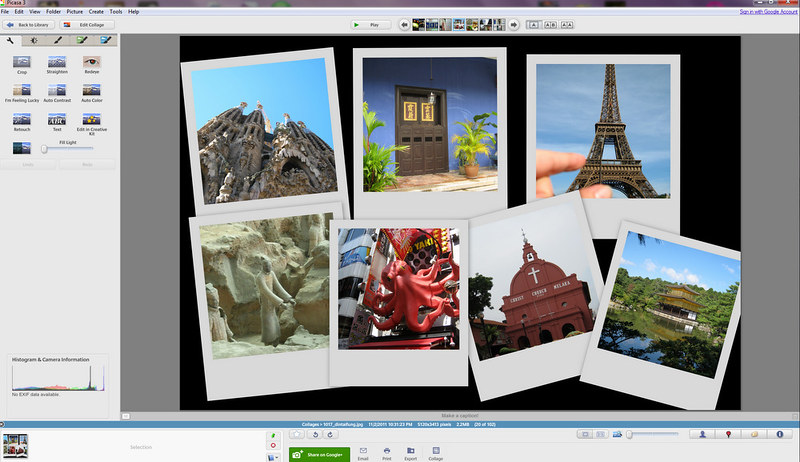
Creating a collage in Picasa

Photos are important as part of the narrative for travel blogging. (Although some take that to the extreme.)

I don’t have Photoshop as I don’t know how to use it (and too cheap to buy it). Instead, I have Picasa which I use to organize my photos as well as crop and resize for images I want to put on the site.

The best feature of this tool is the “Export”, which resizes photos to the pixel length you specify. I find that 1000 pixel makes a good image size.

My free WordPress.com account does not have unlimited storage for images so I am careful to resize photos before putting them up. Exporting the photos also cut down on the size.

By the way, Picasa is owned by Google so you can easily upload your photos to Google Drive from the software.

Download Picasa.

No. 4: Evernote

Ever bookmarked a bunch of cool links and end up forgetting where the bookmarks are or feel too tired to sort through all the content? I did.

That was until I used Evernote. //end of commercial

Just kidding.

I began using Evernote after reading about a couple who were travelling the world without a guidebook.

I use the software and its Chrome widget to “clip” interesting content on the Web. For example, when I was writing my first guest post about Kuching. I “clipped” a few relevant pages from the Internet for reference.

It’s also very useful for travel planning since you have all the pages gathered in an area.

Download Evernote

No. 5: WordPress.com

travel blogging tools
Old school YQ Travelling format

I almost forgot about WordPress.com which is ironic because my blog would not exist without it.

The first post in this blog was written in Xanga because my friend was using it. The mass photo upload function knocked my socks off. Since then, I have cold feet for most activities.

Then I shifted the blog to Posterous because it’s a cute microblog site. Later I found out that the functionality is too limited so I ported it to WordPress.com.

Some people were telling me that I should have started the self-hosted version of WordPress instead. If you, like me, do not know what that means, you can just ignore that sentence.

Perhaps one day I might switch to WordPress.org, but that day is still not here yet.

Extra: LibreOffice Writer

LibreOffice Writer was in my original list of Top 5 but was kicked off the list when I discovered Windows Live Writer.

Instead of writing directly on my WordPress blog, I prefer having my draft on my computer because I can “Undo” more in here.

LibreOffice Writer looks a lot like Microsoft Word. It’s an open source word processing tool. You can write in it like Microsoft Word but you don’t need to pay Microsoft.

I started out using OpenOffice (LibreOffice’s past life) out of spite of Mircosoft. Then I got hooked to it. It feels a lot better than Word, although my boss would say that the Spellcheck is not working as well as Word.

I also use LibreOffice’s version of Excel for budgeting.

So, those are my favorite tools for travel blogging. What are your essential digital tools for travel blogging? Share it in the comments.